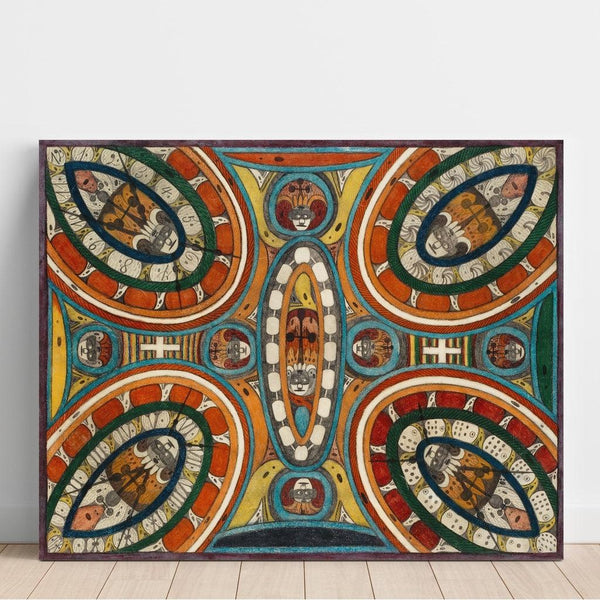
Some works are born far from studios, academies, and salons, in places that art history long ignored. Adolf Wölfli offers one of the most striking examples. Confined for much of his adult life in a Swiss psychiatric clinic, he developed there a graphic universe of rare density, blending drawing, writing, and musical notation. Now recognized as a founding figure of art brut, he continues to intrigue collectors, enthusiasts, and decoration lovers in search of works with a strong character. This article offers a sober and documented journey through his life and work.
Adolf Wölfli, an extraordinary path
Adolf Wölfli was born in 1864 in the canton of Bern, Switzerland, into a modest background. His childhood was marked by poverty, the early loss of his parents, and placement as a farmhand, a harsh and common condition in the rural Switzerland of the time. These difficult years left deep marks on a man whose life collapsed in adulthood, against a backdrop of great precarity and psychological disorders.
In 1895, he was admitted to the Waldau psychiatric clinic, near Bern, where he would spend the rest of his life. The diagnosis given at the time was what medicine then called schizophrenia. It was within this institutional setting, apart from the artistic movements stirring Europe, that Wölfli began to draw around 1899. Cut off from the modernist trends of his time, he developed an entirely personal visual language, with no direct reference to schools or avant-gardes. He died in 1930, leaving behind a body of work of considerable scope.

A total graphic universe: drawing, text, and music
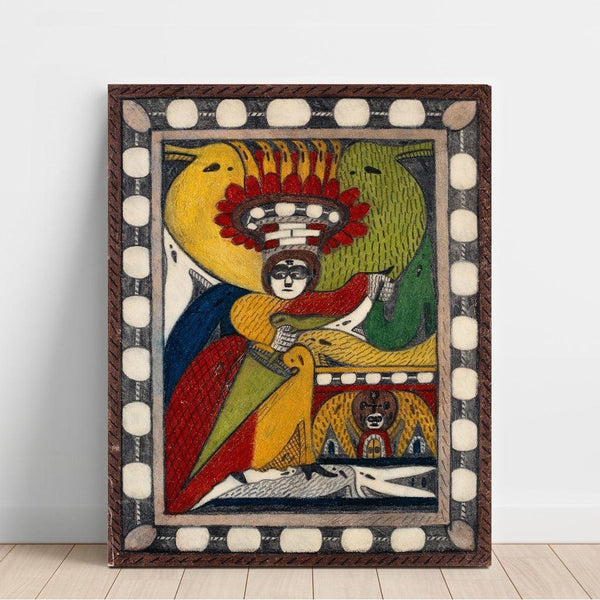
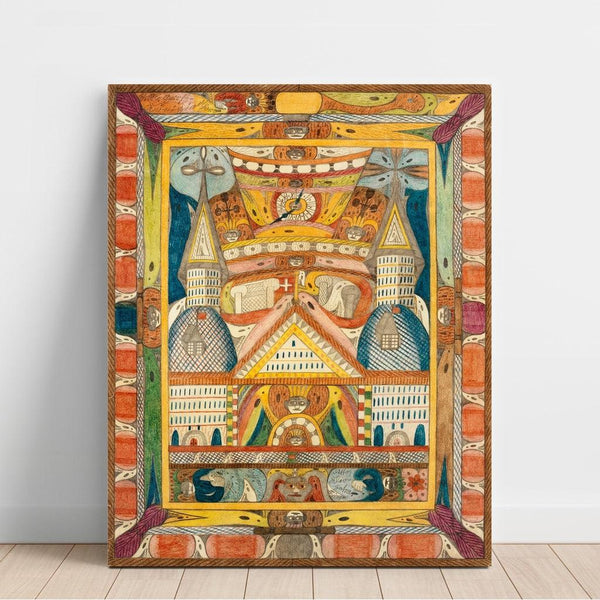
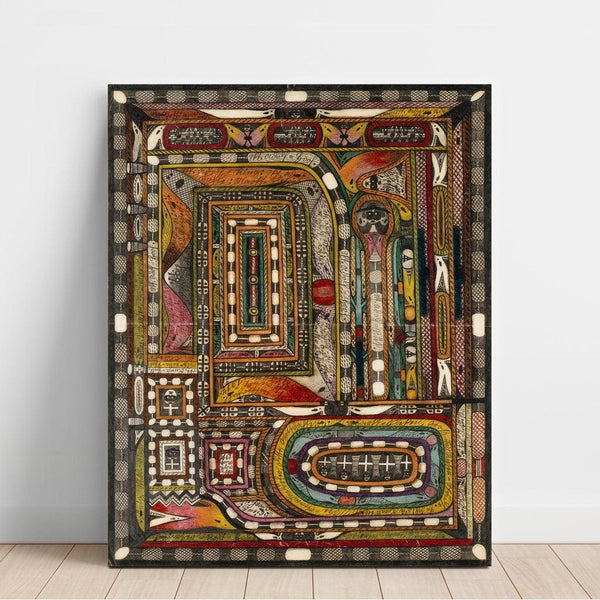
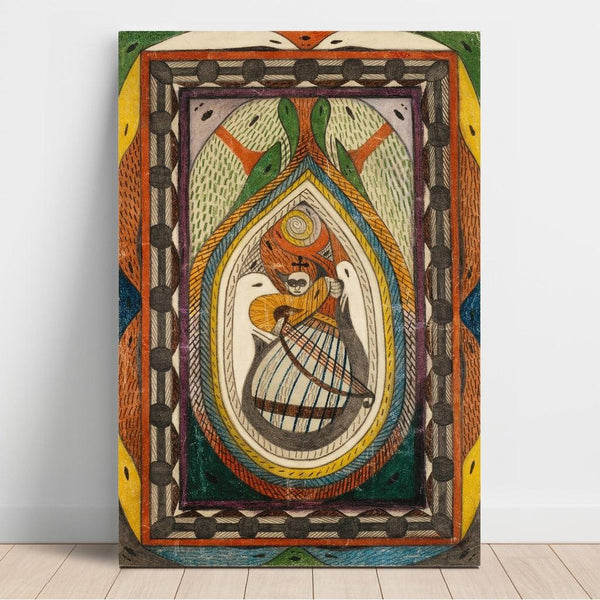
Adolf Wölfli's work stands out for its profusion and internal coherence. On often large sheets, he unfolds dense compositions in which every space is occupied: repetitive motifs, ornamental borders, faces, spirals, architectural elements, and symbols interlock with methodical precision. Empty space is almost absent, replaced by a saturation of forms that gives his pages their distinctive intensity.
What is also striking is the total character of his creation. Wölfli did not limit himself to drawing: he composed a vast autobiographical and imaginary narrative, in which he staged himself and reinvented his own existence in an epic mode. Texts, numbers, fictional cartographies, and musical notations intertwine with the images, forming a whole in which writing and the graphic become inseparable. This monumental work, elaborated over several decades, runs to thousands of pages and constitutes one of the most ambitious projects ever undertaken in the field of art brut.

Color plays an essential role in this endeavor. Wölfli uses vivid hues, structuring his surfaces through interplays of contrasts and visual rhythms. The effect produced is at once that of a musical score and an imaginary map, inviting the eye to circulate without ever quite settling.
From the clinic to recognition: art brut
Wölfli's posterity owes much to the eye of a physician. The psychiatrist Walter Morgenthaler, who observed him at the Waldau, published in 1921 a book devoted to his artist patient, one of the first to seriously consider the output of a mentally ill person as a genuine work of art. This study helped make Wölfli known beyond the walls of the institution and inscribe his name in an emerging reflection on the relationship between creation and psychiatry.

A few decades later, the French artist Jean Dubuffet, theorist of art brut, placed Wölfli among the major figures of this category, which he defined as an art produced outside established cultural circuits, by authors foreign to academic norms. This conceptual framework gave Wölfli's work a lasting recognition and connected it to a broader history, that of a creation freed from conventions. Today, a dedicated foundation preserves and studies his collection within the museum institutions of Bern, ensuring the preservation and dissemination of his legacy.
This gradual recognition changed the status of his work. Long viewed solely through a medical lens, his work is now considered for its own visual qualities, its formal inventiveness, and its singularity, on the same footing as that of other creators who entered the art history of the twentieth century.
Bringing Wölfli's universe into your home

The visual richness of Wölfli's compositions explains the interest they arouse today among decoration enthusiasts. Dense, colorful, and highly structured, they bring a strong presence and a depth to an interior that invite prolonged contemplation. Each work functions as a world in itself, whose details reveal themselves over time and with attentive looking.
Among the pieces available as reproductions, "Miss Iness, at the Piano" illustrates the artist's taste for staging figures within teeming compositions, where the narrative element mingles with ornamentation. "Wand-Uhr-Schlange" (1921-22), for its part, testifies to the way Wölfli transforms simple motifs into complex graphic structures, between geometry and organic proliferation. These two examples give a concrete glimpse of the diversity of his visual vocabulary.
To choose an Adolf Wölfli reproduction is to bring into your home a work at once demanding and generous, carrying a singular history and an immediately recognizable aesthetic. For those who wish to move beyond conventional decorative offerings, his universe offers a cultivated alternative, rooted in one of the most fascinating chapters of twentieth-century art. To discover his creations is also to reconnect with the idea that art can arise from the most unexpected of paths.
Discover the full range of Adolf Wölfli painting reproductions.