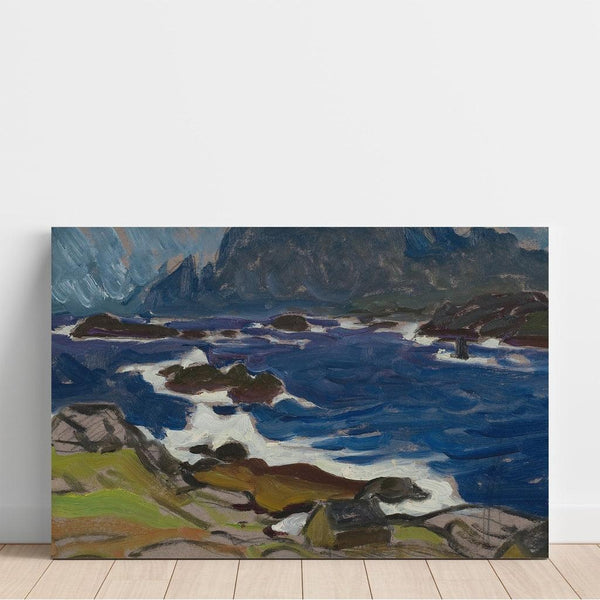
Long overshadowed by the great names of Scandinavian painting, Anna Boberg (1864-1935) now holds a distinctive place in the history of Nordic art. A largely self-taught Swedish artist, she devoted an essential part of her work to the Lofoten Islands, this archipelago in northern Norway whose light, mountains and sea she painted for nearly three decades. Her work, at the crossroads of landscape and exploration, deserves to be rediscovered for its coherence and its singularity.
A path between Stockholm and the Far North
Born in Stockholm in 1864, Anna Boberg grew up in an environment where art and architecture held a central place: she was the daughter of the architect and artist Fredrik Wilhelm Scholander. In 1888, she married Ferdinand Boberg, one of the most prominent Swedish architects of his time. This marriage brought her into the cultural circles of the capital, but it was through a personal path, largely on the margins of academic institutions, that she came to painting.
Essentially self-taught, Anna Boberg trained through practice, observation and travel. This absence of conventional academic training, often highlighted by critics, partly explains the freedom of her manner and her independence from the dominant schools. Nor did she confine herself to painting, exploring several fields of the decorative arts throughout her life.

The turn of the twentieth century was, for women artists, a period of gradual gains but still strewn with obstacles. In this context, Anna Boberg's position was doubly singular: a woman in a largely male milieu, she was also a creator who refused to be confined to a single genre or a single technique. Her career illustrates the way in which a personal vocation, nourished by travel and the direct experience of the motif, could assert itself outside the official channels of artistic training.
The Lofoten Islands, an open-air studio
The decisive encounter of her career was with the Lofoten Islands, which she discovered at the very beginning of the twentieth century and to which she would return regularly for some thirty years. This land of steep mountains plunging into the sea, of fishing villages and shifting skies became the central motif of her work. She painted there in all seasons, braving the cold, the polar night and difficult conditions to capture on the spot the variations of the Arctic light.
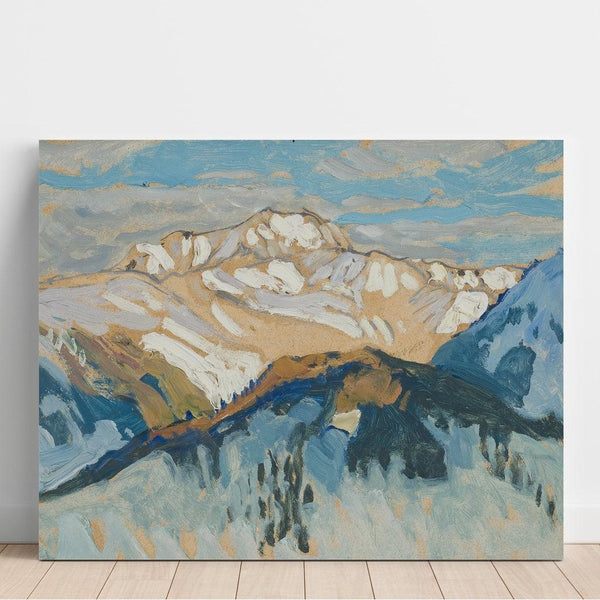
Her canvases often bear the mention of "study," revealing an approach based on direct observation and repeated confrontation with the same landscape. Works such as Night over Store Molla. Study from Lofoten or Vaagakallen. Study from Lofoten testify to this attachment to precise places in the archipelago — the island of Store Molla, the summit of Vågakallen — which she depicted at different times and under different light.
The choice of the Lofoten Islands was in no way trivial. By settling, season after season, in an archipelago renowned for the harshness of its climate and the isolation of its fishing communities, Anna Boberg made physical constraint a very component of her art. To paint the North is to accept its rigours, and this endurance shows through in the constancy with which she returned to the same horizon, as if to exhaust all its nuances.
This repeated approach to the same territory brings Anna Boberg close to a form of exploration painting, in which the artist documents as much as she interprets. The sea, the snow, the reflections and sometimes the nocturnal lights of the North make up a coherent visual repertoire, marked by a constant attention to atmosphere rather than to anecdote.
An artist of many facets
To reduce Anna Boberg to her Nordic landscapes alone would be to overlook the breadth of her activity. Beyond painting, she took an interest in the applied arts and worked in fields as varied as textiles, ceramics and glass. She also distinguished herself in the design of sets and projects linked to the stage, and left writings as well.
This versatility was in keeping with the spirit of her time, when the boundaries between fine arts and decorative arts tended to blur, notably in the wake of the movements devoted to the renewal of the applied arts. In Anna Boberg, this manifold curiosity did not scatter the work: it confirmed its coherence, that of a creator attentive to material, colour and light in all their forms.
This openness to different disciplines no doubt nourished her painter's eye. The attention paid to the effects of material, to the transitions of colour and to the play of light that one observes in her landscapes seems to extend, on the canvas, one and the same overall sensibility. Far from being secondary activities, these forays into the applied arts were part of a demanding and coherent conception of creation.
A late recognition and a renewed legacy

During her lifetime, Anna Boberg received a mixed reception. While her work found an echo abroad, it long remained underestimated in Sweden, where her singularity and her status as a self-taught woman artist did not make institutional recognition easy. It was often only after her death, in 1935, that the value of her Nordic work was fully reassessed.
Today, her Lofoten landscapes are valued for their sincerity and their evocative power, and part of her work is held in Swedish public collections. This rediscovery is accompanied by a renewed interest among enthusiasts in an art that combines rigour of observation with a sensitivity to the Nordic sublime.
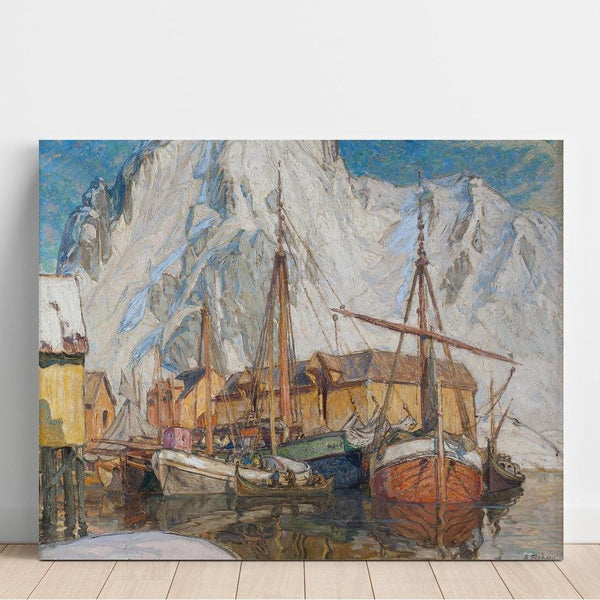
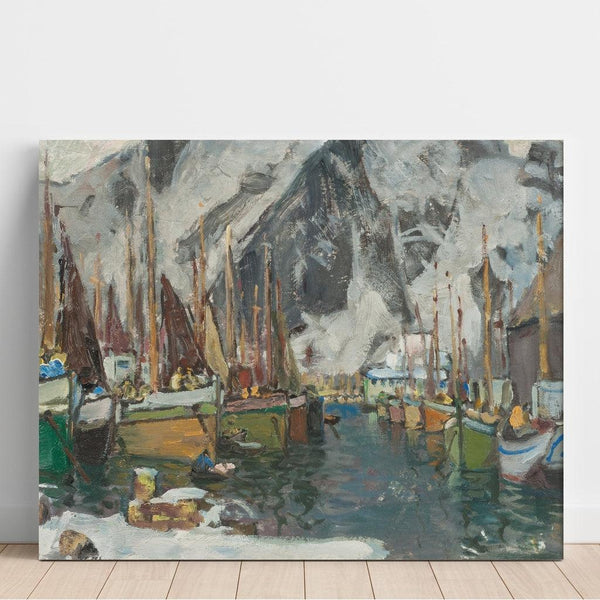
For those who wish to bring this world into their home, several reproductions offer a way to approach the spirit of her work, such as the Painting Svolvær Harbour at the Height of the Fishing Season, Study from Lofoten or the Painting Beach. Study from Northern Norway. These images extend, in their own measure, the gaze that Anna Boberg cast upon the shores of the Far North, between the labour of the fishermen and the immensity of the landscape.
Discover the full range of Anna Boberg painting reproductions.