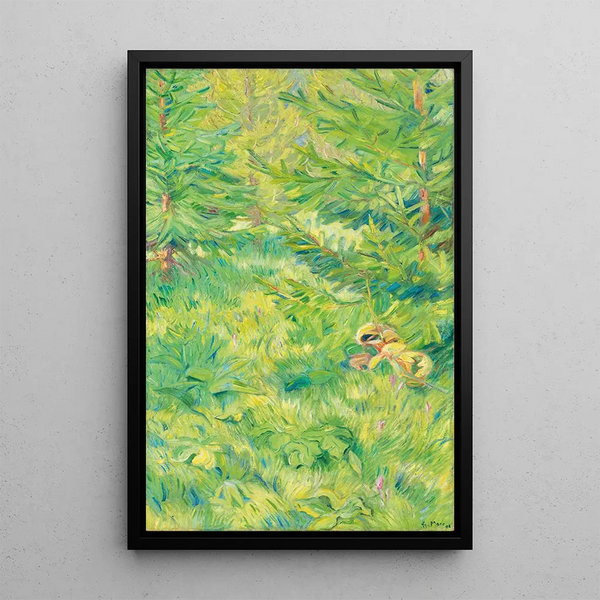
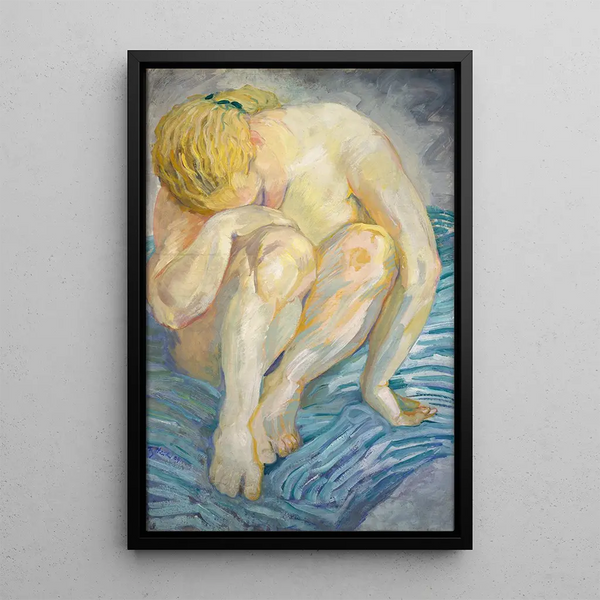
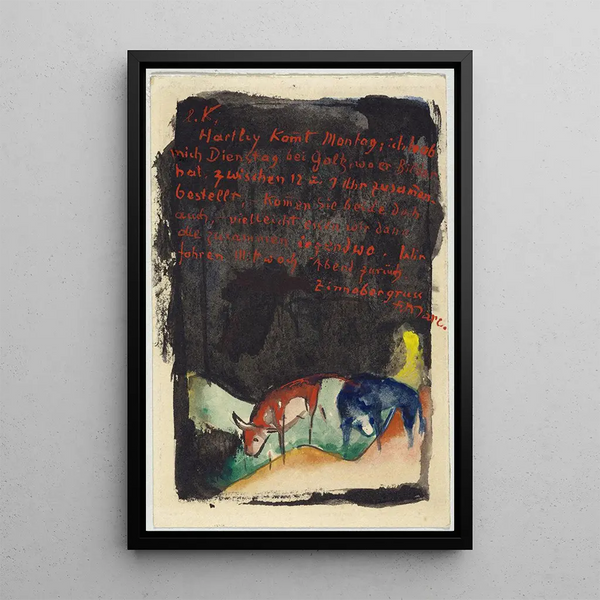
Few painters, in a career cut short by war, managed to transform the depiction of the animal world into such a coherent spiritual language. Franz Marc belongs to that small circle. A central figure of German Expressionism and co-founder of the Blaue Reiter movement, he made the horse, the deer and the cow the protagonists of a painting in which colour becomes a bearer of meaning. His canvases, with their bold hues and simplified forms, now rank among the milestones of early twentieth-century modern art. This article offers a sober and documented journey through his life, his influences and some of his most significant works.
Franz Marc, a short and intense trajectory
Franz Marc was born on 8 February 1880 in Munich, in an environment where art was no stranger: his father, Wilhelm Marc, was a landscape painter. After considering studies in theology and philosophy for a time, the young man turned to painting and attended the Munich Academy of Fine Arts at the turn of the century. Travel played a role in his training, notably his stays in France, where he discovered the painting that was then transforming Europe.
His career proper was brief. It was above all from the late 1900s and the early 1910s that Franz Marc asserted a personal style, before the First World War abruptly interrupted his work. Called up for service, he died on 4 March 1916 near Verdun, at the age of thirty-six. This early death did not prevent his work from exerting a lasting influence: German and international public collections now hold several of his most famous canvases.

The Blaue Reiter and the influences of an era
One cannot understand Franz Marc without placing him back within the artistic ferment of his time. His early works bear the mark of Impressionism and Post-Impressionism, and the example of Vincent van Gogh is among those that left a lasting impression on him through the intensity of colour and the expressiveness of the brushstroke. In Munich, his meeting with the painter August Macke forged a decisive friendship, built on exchanges about colour and pictorial modernity.
In 1911, Franz Marc joined forces with Wassily Kandinsky to found the Blaue Reiter, "the Blue Rider," one of the major centres of German Expressionism. The group published an almanac bringing together texts and reproductions, and championed a spiritual conception of art, open to folk art, children's art and non-European traditions. Marc was also interested in the formal explorations of his time, from Cubism to Futurism, as well as in the colour interplay of Orphism embodied by Robert Delaunay. These contributions nourished a body of work in which geometric construction and chromatic vibration answer one another.

Colour and the animal as language
The most recognizable trait of Franz Marc lies in the way he placed the animal at the heart of painting. In his work, the horse, the tiger, the deer or the cow are not mere picturesque motifs: they embody a form of innocence and harmony with nature, a purity that the artist readily set against the complexity of the human world. This empathy towards the animal kingdom gives his canvases a contemplative, at times almost mystical, dimension.
To this vision is added a reflection on the symbolic value of colours. Franz Marc formulated correspondences between tones and spiritual qualities, associating for instance blue with a grave and spiritual dimension, yellow with gentleness and joy, red with matter and its heaviness. This chromatic grammar, without being a rigid system, sheds light on the internal logic of many works: colour does not describe the visible world, it expresses its inner meaning. The forms, simplified and energized, extend this exploration by organizing the surface like a rhythm.

Towards the end of his life, Franz Marc pushed this logic further and moved towards an increasingly abstract painting, where animal forms sometimes dissolve into an interplay of coloured planes. This evolution reflects a coherent trajectory, from the realism of his beginnings to a nascent abstraction that the war would leave him no time to deepen.
From emblematic works to reproductions
Among the works that best embody the art of Franz Marc, The Tower of Blue Horses holds a singular place. Painted in 1913, this monumental composition gathers horses of a deep blue into an architecture rising towards the sky, where animal power turns into an almost spiritual surge. The eventful history of this painting, which disappeared during the Second World War, has reinforced its status as an icon and fed the public's attachment to the artist.

The Yellow Cow, created in 1911, illustrates for its part the dazzling use of colour that characterizes Marc. The animal, caught in a leaping movement, stands out against a landscape of vivid tones, and the yellow hue there deploys precisely that value of gentleness and joy which the painter attributed to it. These two works, often cited, on their own sum up the main thrusts of his approach: the centrality of the animal, the simplification of forms and the symbolic charge of colour.
The equestrian theme, so present in his work, is found in compositions such as Horses at Rest, available as a reproduction for those who wish to bring this world of coloured serenity into their home. Such a reproduction makes it possible to approach, on a domestic scale, the sensibility of a painter whose originals are now carefully preserved in museums. It thus extends, within a private setting, the contemplation of an art that has lost none of its evocative power more than a century after its creation. The work of Franz Marc remains an invitation to look at the world differently, through the prism of a colour become thought.
Discover the full range of Franz Marc painting reproductions.