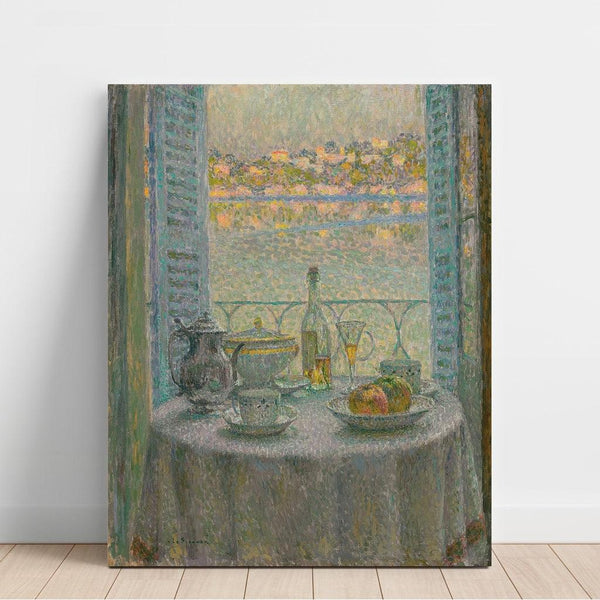
Discreet among the great names of French painting at the turn of the twentieth century, Henri Le Sidaner holds a singular place, at the crossroads of late impressionism, symbolism and intimism. A painter of tables set in gardens, of deserted lanes and twilight glows, he built a patient, contemplative body of work in which the absence of human figures leaves the atmosphere entirely to itself. Long prized by collectors and regularly rediscovered, his art continues to exert a seduction made of silence, nuance and quiet meditation. This article looks back at his career, his style and a few of his works, in order to shed light on his legacy.
Henri Le Sidaner, a singular trajectory
Henri Le Sidaner was born in 1862 in Port Louis, on the island of Mauritius, then a British possession. His family later settled in the north of France, in Dunkirk, a port city whose shifting skies and coastal light would leave a lasting mark on his sensibility. Drawn to painting from an early age, he made his way to Paris to train at the École des Beaux-Arts, where he attended the studio of Alexandre Cabanel, a figure of academic painting. The young artist nevertheless soon moved away from this official teaching to seek a more personal path.
Like many painters of his generation, Le Sidaner spent time on the coast, notably at Étaples, where an artists' colony had taken shape. He also travelled abroad, discovering the cities of Belgium, the Netherlands, Italy and England, so many stages that enriched his eye and his palette. From these journeys he retained less the picturesque than the atmosphere of places, the particular quality of a light or the calm of a square at nightfall. A member of the Société Nouvelle des peintres et sculpteurs and supported by the dealer Georges Petit, he enjoyed solid recognition in his lifetime, in France as internationally, until his death in 1939.

An art of intimism and light
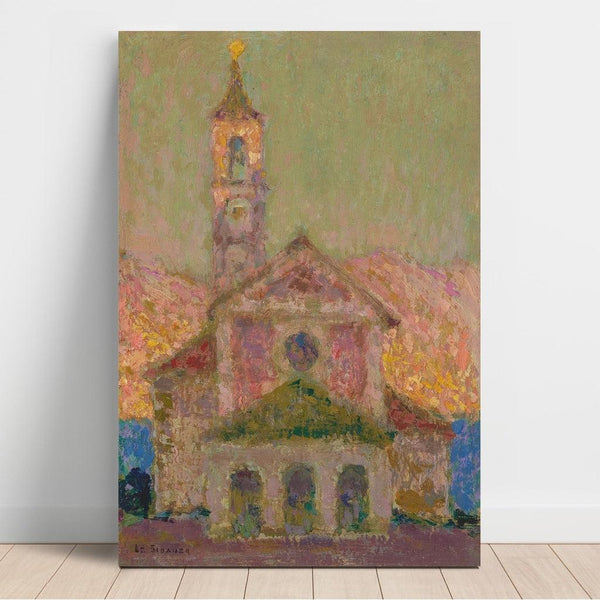
Henri Le Sidaner's style resists confinement within a single school. He is readily associated with intimism, the movement that favours contemplative scenes and hushed atmospheres, while his debt to impressionism and his interest in the divided brushwork of the neo-impressionists are equally acknowledged. From these crossed influences he drew a manner of his own: a painting of delicate tones, built up through small vibrant touches, which seeks less to describe a motif than to convey its emotional climate.
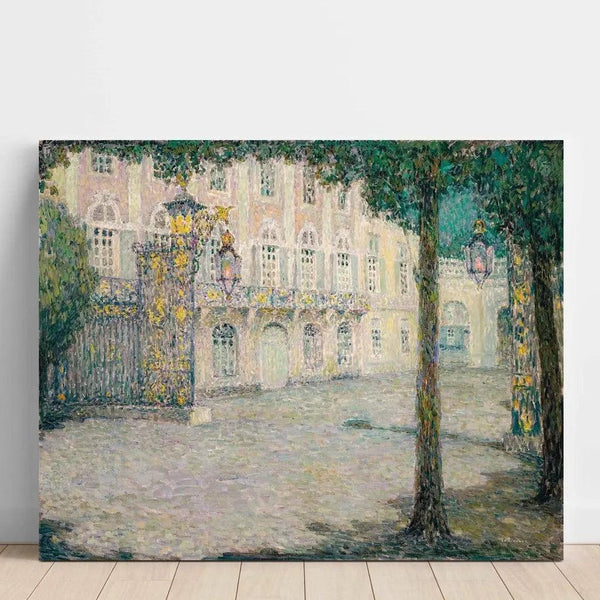
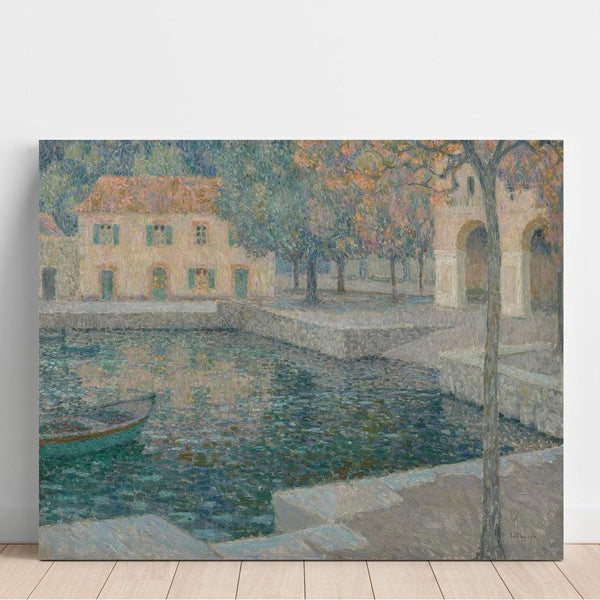
Light is at the heart of his approach. Le Sidaner favoured the in-between hours, those of dusk, of falling evening or of moonlight, when contours blur and colours grow subtle. Reflections, the gleam of a lit window, the softness of a fading sky become subjects in their own right in his work. This attention to subtle transitions gives his canvases a poetic tonality, at times tinged with melancholy, yet always imbued with serenity.

A striking feature of his work is the near-total absence of figures. His set tables, his interiors and his village squares seem inhabited by an invisible presence, as if the people had only just left the scene. This choice is far from anecdotal: it invites the viewer to fill the silence for themselves, to imagine the life suspended around these objects and places. Herein lies all the suggestive power of his painting, which transforms simple motifs into moments of contemplation.
Gerberoy, gardens and towns of silence
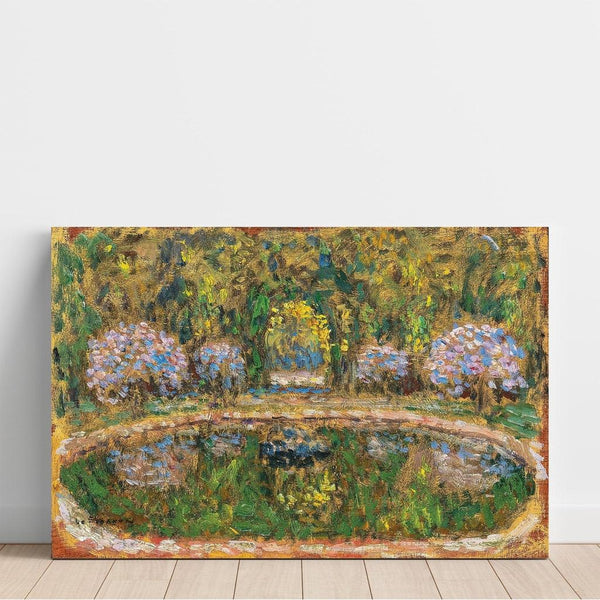
In the early twentieth century, Henri Le Sidaner became attached to the village of Gerberoy, in the Oise, where he made a home and shaped gardens that would become an inexhaustible source of inspiration. This setting provided him with a repertoire of recurring motifs: flowering terraces, tables set in the shade of foliage, ancient walls and rose gardens bathed in a softened light. Far from being a mere backdrop, this carefully cultivated garden functioned as a true open-air studio, where the artist observed the play of the seasons and the hours.

Answering the intimate landscapes of Gerberoy are the urban views that Le Sidaner brought back from his travels and stays. He painted towns steeped in history, where architecture and stone served as a setting for his explorations of light. Among his subjects, the cathedral of Chartres and its stained-glass windows hold a notable place, as a work such as The Stained-Glass Window, Chartres testifies, where the clarity filtered through the coloured glass offers an ideal pretext for his taste for nuance. Elsewhere, cultivated fields inspired more expansive compositions, as in a Field of Poppies where colour punctuates the open expanse.
Major works and legacy
Among Henri Le Sidaner's most emblematic motifs are his tables set out in the open air, of which The Table and The Dessert are representative examples. On these canvases, a porcelain service, some fruit or glasses arranged on a pale cloth are enough to compose a scene full of intimacy. The evening light plays on the whites, reveals the reflections and envelops the whole in a peaceful atmosphere. These outdoor still lifes sum up the painter's poetics on their own: celebrating the simple beauty of a moment, without emphasis or apparent narrative.

Le Sidaner's legacy rests precisely on this coherence. Where others sought rupture, he patiently deepened a world recognisable among all, made of silence, softness and restraint. This constancy explains the enduring attachment of enthusiasts to his work, and the interest that collectors continue to show in it. Canvases such as The Stained-Glass Window, Chartres or Field of Poppies, now available as reproductions, make it possible to bring a fragment of this art of nuance into one's home.
To rediscover Henri Le Sidaner is to agree to slow down one's gaze. His paintings do not seek to impress through anecdote or spectacular effect, but to create a space of quiet meditation where light, colour and atmosphere take precedence over the subject. In a world saturated with images, this painting of silence retains a rare, soothing power, and his legacy deserves the full attention of anyone interested in the sensibility of the late nineteenth and early twentieth centuries.
Discover the full range of Henri Le Sidaner painting reproductions.