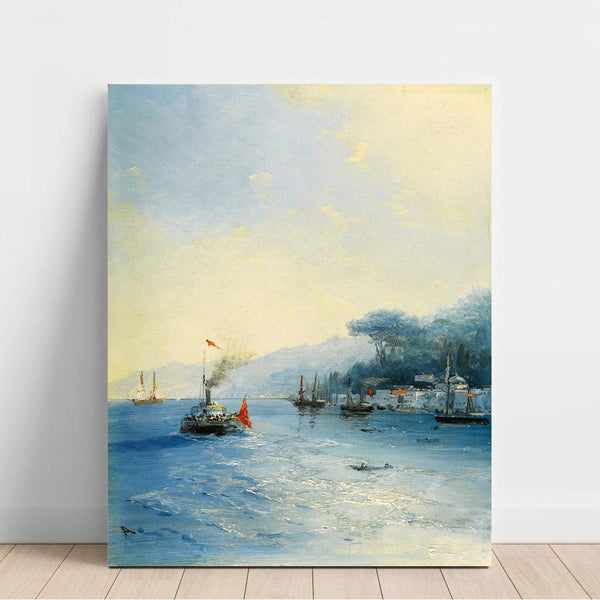
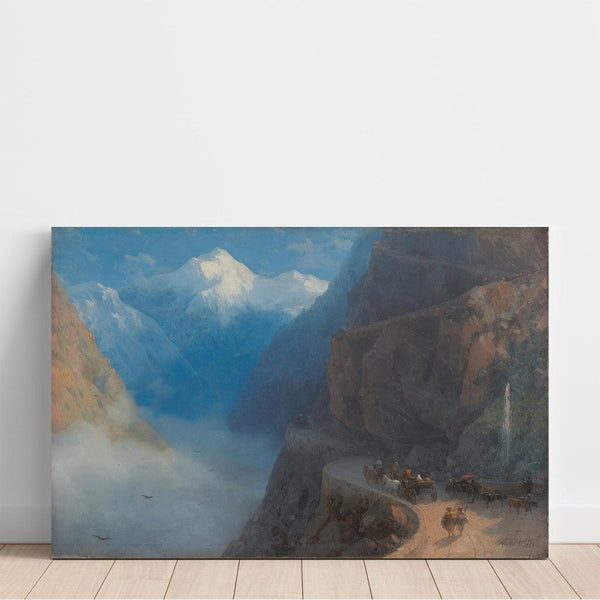
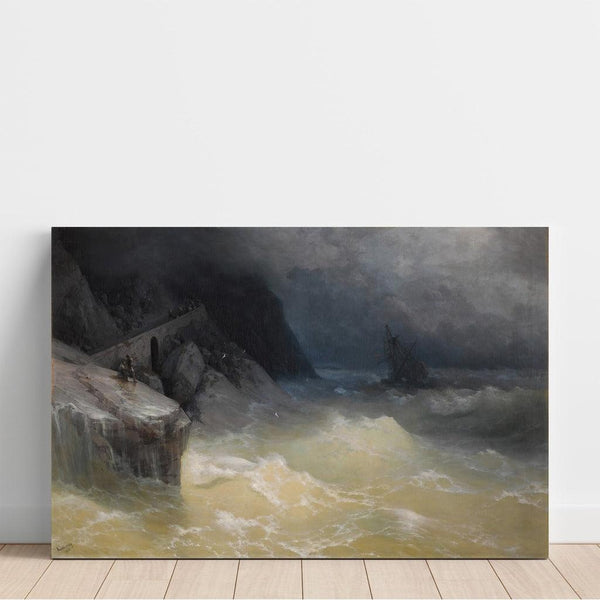
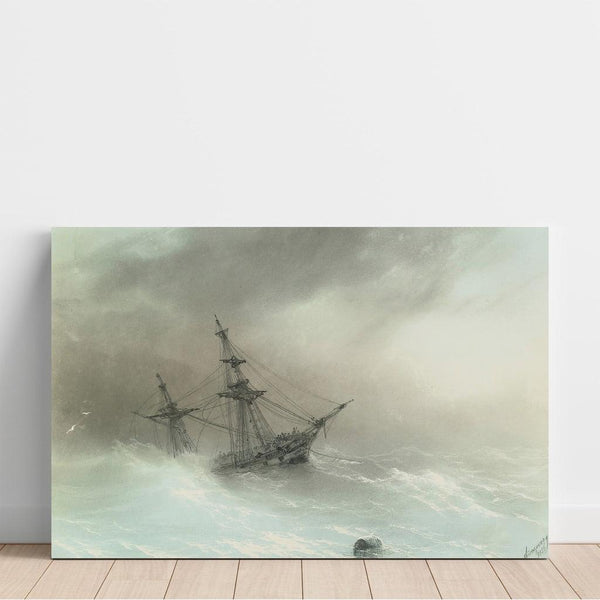
Few artists have devoted their entire lives to a single subject with as much constancy as Ivan Konstantinovich Aivazovsky. A nineteenth-century Russian painter of Armenian descent, he is recognised today as one of the greatest masters of marine painting of his era. His long and exceptionally productive career unfolded almost entirely around the sea: its luminous calms, its storms, its moonlit nights and its naval battles. Through a command of light and movement rarely equalled, Aivazovsky captured on canvas the ever-changing power of the waves and left behind a body of work that continues to fascinate lovers of seascapes.
Who was Ivan Konstantinovich Aivazovsky?
Ivan Konstantinovich Aivazovsky was born in 1817 in Feodosia, a port town in Crimea, into a family of Armenian origin. This coastal setting, where merchant ships and fishing boats crossed paths, left a lasting mark on the young artist's eye. His early talent earned him a place at the Imperial Academy of Arts in Saint Petersburg, then the central institution for the training of Russian painters. He quickly distinguished himself there and turned towards marine landscape painting, a genre to which he would devote most of his life.
After his studies, Aivazovsky travelled and lived in Europe, notably in Italy, where he deepened his understanding of Mediterranean light and the landscape tradition. On his return to Russia, he became the official painter of the navy, a position that gave him access to naval scenes and fleet campaigns. He nonetheless chose to settle permanently in his native town of Feodosia, remaining faithful to the shores of the Black Sea that had nourished his first impressions. It was there that he worked for most of his career, far from the fashionable circles of the capitals.

An art of light and movement
What sets Aivazovsky apart is his ability to render the sea in all its mobility. The transparency of the water, the foam of the waves, the reflection of the sun or the moon on the surface of the waves are among the motifs he explored with unfailing virtuosity. His painting belongs to the Romantic sensibility of the nineteenth century, attentive to the grandeur of nature and the fragility of man in the face of the elements. Storms and shipwrecks sit alongside peaceful seascapes bathed in a golden light.
Part of his singularity lies in his working method. Aivazovsky most often painted from his visual memory rather than from life, which allowed him to compose scenes with great freedom and to treat atmospheric effects that were difficult to capture on the spot. This approach also explains the speed and abundance of his output, which numbers several thousand works spread over nearly sixty years of activity. Moonlit scenes, in particular, hold a notable place in his repertoire: moonlight gliding over dark water, outlining the silhouette of a ship, is one of the motifs with which his name remains lastingly associated.

His territory is not only maritime. Aivazovsky also depicted land-based landscapes, notably the steppes and countryside of the South, where he brings the same feeling for sky and horizon into play. The region's night scenes, lit by the moon, extend onto dry land that pursuit of atmospheric light which runs through his entire body of work.
Works that left their mark on marine painting
Among Aivazovsky's most famous paintings is “The Ninth Wave”, a dramatic composition in which survivors of a shipwreck confront the swell beneath a blazing sky. The work condenses the major traits of his art: the imposing scale of the sea, the intensity of the light and the tension between destruction and hope. “The Black Sea” reflects a different, more pared-down register, in which the artist concentrates attention on the vastness of the waves and the depth of the sky, demonstrating his mastery of contrasts and of the variations of light.

The painter's official career also led him to treat historical and military subjects. “The Battle of Chesma” stages a naval clash between the Russian and Ottoman fleets, a subject in which Aivazovsky combines the documentary precision expected of a marine painter with a spectacular sense of light and smoke. In the same vein tied to the history of his time, one might mention “Alexander II Crossing the Danube”, which links his art to the political and military events of nineteenth-century Russia.
His time in Italy shows through in luminous scenes inspired by the Mediterranean coasts, such as “Fishermen Returning Near Naples”, where the softness of the southern light contrasts with the more turbulent seascapes of the Black Sea. These works are a reminder that, beyond the storms that made his reputation, Aivazovsky was also a painter of calm, of evening light and of peaceful shores.
A lasting legacy

Aivazovsky enjoyed considerable recognition during his lifetime, both in Russia and abroad, which remains rare for an artist attached to a genre as specialised as marine painting. Devoted to his town of Feodosia, he supported local life there and helped to create a gallery intended to preserve and present his works, which remains a key destination for anyone wishing to discover his art. His death, at the dawn of the twentieth century, marked the end of one of the most prolific careers in Russian landscape painting.
To this day, his name remains a benchmark for marine art. His compositions continue to be exhibited, studied and appreciated for their treatment of light and their sense of atmosphere. For a lover of landscape painting, approaching Aivazovsky means rediscovering a way of viewing the sea as an endlessly renewed spectacle, poised between serenity and fury.
We offer several reproductions inspired by his world, among them “Ukrainian Landscape at Night” and “Ship by Moonlight”, two motifs representative of his taste for nocturnal light and atmospheric effects. They offer an accessible way to bring into one's home the sensibility of a painter who, throughout his life, sought to capture the elusive movement of the waves and the shifting clarity of the sky.
Discover the full range of Ivan Konstantinovich Aivazovsky painting reproductions.