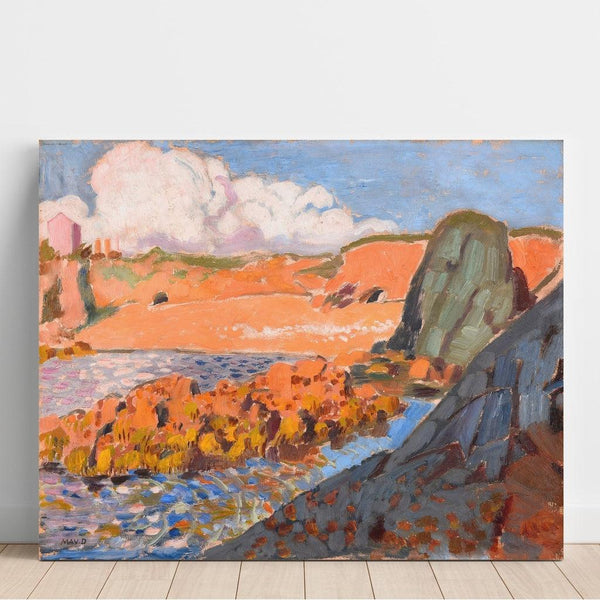
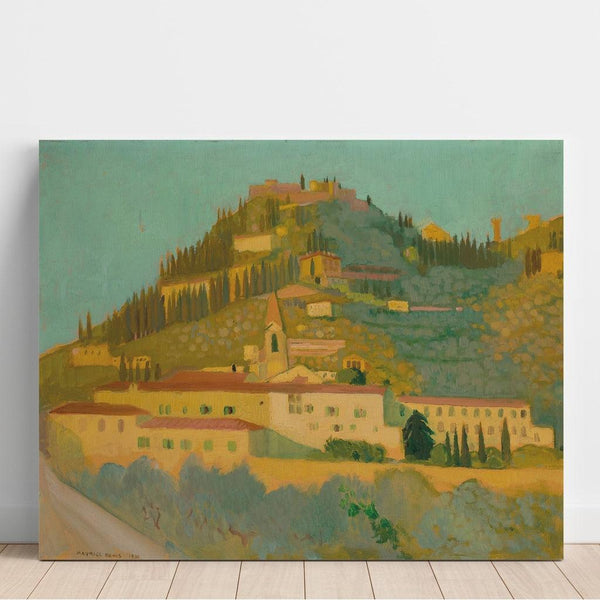
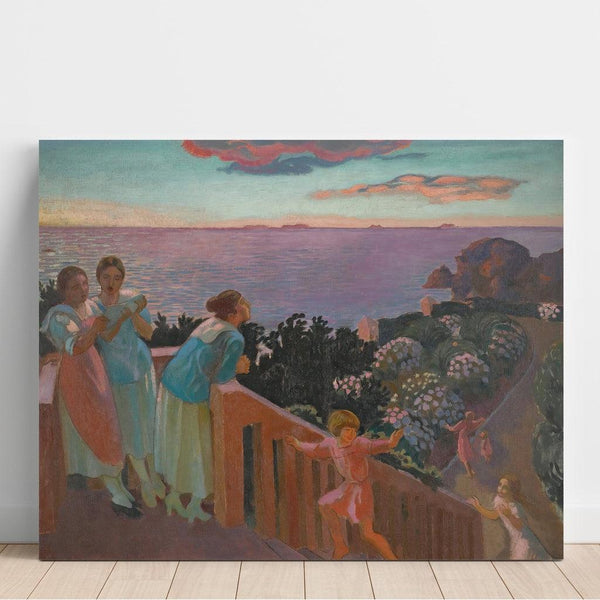
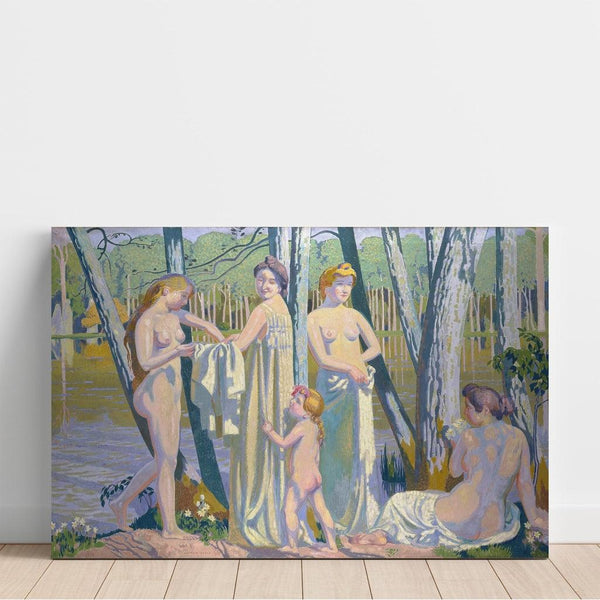
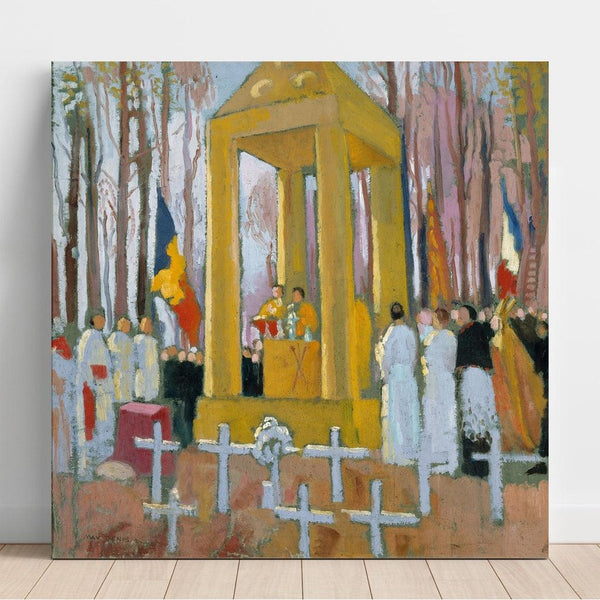
A painter, decorator and theorist, Maurice Denis (1870-1943) holds a singular place in the history of French art at the end of the nineteenth century. A central figure of the Nabis group, he was also one of the few artists of his generation to combine the practice of the brush with written reflection, leaving behind a body of theoretical work whose influence extends far beyond the circle of his contemporaries. His career, marked by a deep Catholic faith and by the desire to renew painting, sheds light on a decisive moment: the one in which art detached itself from naturalism to assert the freedom of its means. This overview sets out to trace the broad lines of his career and to situate a few emblematic works that our gallery brings to light.
A Parisian training, from the Lycée Condorcet to the Académie Julian
Born in Granville in 1870, Maurice Denis grew up in Saint-Germain-en-Laye, in the Paris region. As an adolescent, he attended the Lycée Condorcet in Paris, where he formed decisive friendships with future artists, among them Édouard Vuillard and Ker-Xavier Roussel. This period nurtured in him a twofold vocation: drawing and reflection on art, which he recorded very early in a diligently kept journal.
His training continued at the Académie Julian, a private institution to which many young painters then flocked, as well as at the École des Beaux-Arts. It was at the Académie Julian that Denis met Paul Sérusier, Pierre Bonnard, Paul Ranson and other companions with whom he would soon found a group. This learning environment, where academic teaching and impassioned discussions about new trends intersected, allowed him to strengthen a critical eye and to gauge the gap between tradition and the experiments stirring the artistic scene.

The theorist of the Nabis
At the end of the 1880s, Sérusier brought back from Pont-Aven a small study painted under the guidance of Paul Gauguin, which his friends would nickname "the Talisman". This work, in which colour freed itself from a faithful description of the subject, acted as a revelation. Around Denis the Nabis group then took shape, a term borrowed from Hebrew and meaning "prophets". These young artists shared the ambition of breaking with the imitation of nature in order to favour the synthesis of forms, flat areas of colour and the decorative value of the painted surface.
Maurice Denis quickly became the theoretical voice of the movement. In 1890, he published in the review Art et Critique a text entitled "Definition of Neo-Traditionism", which opens with a sentence that has remained famous: a painting, before being a subject of any kind, is essentially a flat surface covered with colours assembled in a certain order. This formula, often cited as a foreshadowing of modern research on the autonomy of painting, sums up the group's aesthetic orientation. It affirms the primacy of the pictorial means over the anecdote and gives the arrangement of colours a value of its own.

This reflection is not exercised at the expense of the subject, but in dialogue with it. In Denis's work, theory serves a vision in which painting can once again become a spiritual language, capable of expressing inner life and the sacred as much as the visible world. He thus embodies a particular position within the Nabis, between intellectual rigour and religious sensibility.
Faith, colour and sacred art
The religious dimension runs through the whole of Maurice Denis's work. A fervent Catholic, he aspired to renew sacred art, which he then judged to be ossified by convention. His compositions on religious subjects often transpose scenes of Scripture into contemporary or familiar settings, blending everyday life and mystery. This approach seeks to make spirituality accessible and present, far from a frozen imagery. Among the motifs dear to him is that of the Annunciation, which he treated on several occasions and which is illustrated by a reproduction offered by our gallery, the Painting Annunciation in the Spring Garden - Maurice Denis, in which the sacred scene unfolds within the gentleness of an awakening garden.

After the First World War, this commitment continued in a concrete undertaking: alongside George Desvallières, Denis took part in the founding of the Ateliers d'art sacré, intended to train artists in the decoration of religious buildings. His palette, clear and harmonious, and his taste for balanced compositions found in this field a privileged terrain of expression. Sacred art was not for him a marginal speciality, but the heart of a conception in which beauty and faith answer one another.
Works, decorations and legacy
The name of Maurice Denis remains attached to several works that mark out his path. Homage to Cézanne, painted in 1900 and held at the Musée d'Orsay, gathers around a still life by the master of Aix the figures of the Nabis and their circle; the painting stands both as a group portrait and as a declaration of artistic lineage, bearing witness to the admiration this generation held for Paul Cézanne. Brittany also occupies an important place in his work, as attested by Breton Women under the Arbour, in which his attachment to the region and his sense of intimate scenes bathed in light come together.

This taste for family life and peaceful settings can still be read in the Painting The Arbour, Ker Guen - Maurice Denis, of which our gallery offers a reproduction. The arbour, a recurring motif, offers the painter a play of shadow and light conducive to the decorative harmony he sought, and reveals an art of domestic serenity. These compositions, in which the figures blend into an environment treated with delicacy, extend the principles set out from his earliest writings: the harmony of colours and the unity of the surface take precedence over mere description.
Denis was also a prolific decorator, sought after for mural ensembles and public decorations, and a recognised illustrator. His house in Saint-Germain-en-Laye, the former priory he lived in, is today a departmental museum devoted to his work and to that of the Nabis. A theorist who was listened to, a fertile practitioner and a bridge between symbolism and the experiments of the twentieth century, Maurice Denis leaves a legacy whose richness stems precisely from this alliance of thought and craft. To rediscover his works, or to welcome a faithful reproduction of one, is to reconnect with a moment when painting reaffirmed, with restraint and conviction, the value of its own means.
Discover the full range of Maurice Denis painting reproductions.