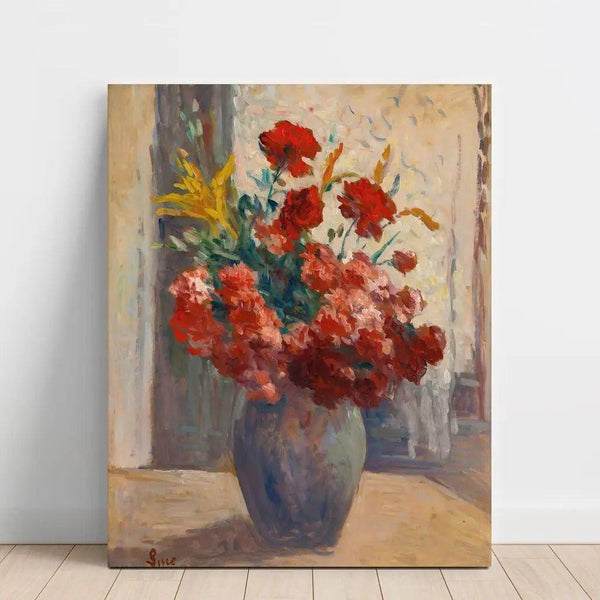
Long overshadowed by Georges Seurat and Paul Signac, Maximilien Luce nonetheless holds a singular place within French Neo-Impressionism. Born in Paris in 1858 and dying in the same city in 1941, he spanned more than six decades of creation, from wood engraving to large Pointillist canvases, without ever abandoning a gaze deeply attached to the real world. A painter of light as much as of people, he knew how to marry the rigour of a learned technique with a human sensibility rarely belied. This journey, at once aesthetic and committed, deserves to be rediscovered by every art lover attentive to the currents that shaped the end of the nineteenth century.
A Parisian Engraver Turned Painter
Maximilien Luce grew up in Paris in modest surroundings and first trained in the crafts of engraving. An apprentice and then a wood engraver, he acquired very early a discipline of line and an intimate knowledge of the print that would leave a lasting mark on his work. This artisanal training, long regarded as secondary to painting, gave him a keen sense of composition and contrast, qualities found again in his most accomplished canvases.

It was gradually, over the course of the 1880s, that he devoted himself fully to painting. His encounter with the artists of the Parisian avant-garde proved decisive. By mixing with Camille Pissarro, Paul Signac and Georges Seurat, he discovered the principles of the emerging Neo-Impressionism and joined the circle of the Indépendants. These friendships, founded as much on artistic affinities as on shared convictions, guided him towards a new way of treating colour and light, while confirming him in his taste for subjects drawn from ordinary life.
Neo-Impressionist Technique and the Question of Light
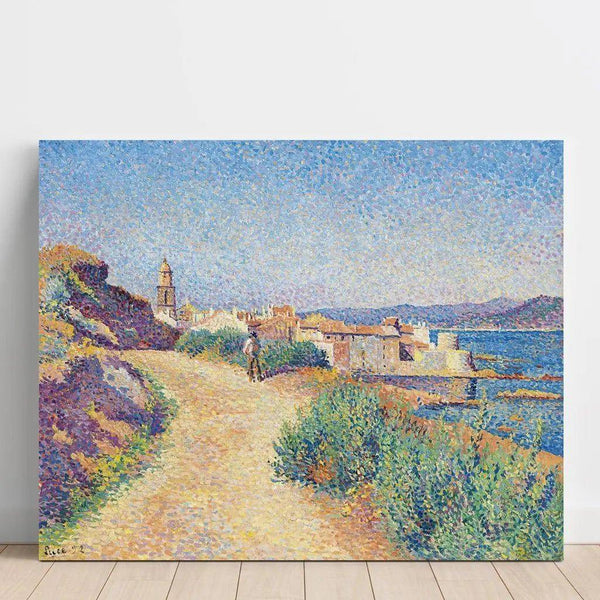
Neo-Impressionism, also called Pointillism or Divisionism, rests on the juxtaposition of small strokes of pure colour that the viewer's eye recomposes from a distance. Luce adopted this method with conviction, but he tempered its theoretical rigour with a personal sensibility. Where some of his contemporaries sought an almost scientific application of the division of tone, he retained a vigorous handling and a constant attention to the substance of the landscape, to the solidity of things and to the presence of human labour.

His landscapes of the Paris region rank among the most appealing testimonies to this pursuit. “The Seine at Herblay” illustrates his way of capturing the vibration of light on the water and the banks, in a mosaic of strokes where the river becomes a shifting play of reflections. In a more southern register, “The Rocks at Agay” attests to his interest in the shores of the Mediterranean, whose mineral brilliance and clarity he renders through a luminous palette. This work, now offered as a reproduction, lets us gauge the ease with which Luce set the structure of the landscape in dialogue with the finesse of the divided stroke.
A Social Commitment at the Heart of the Work
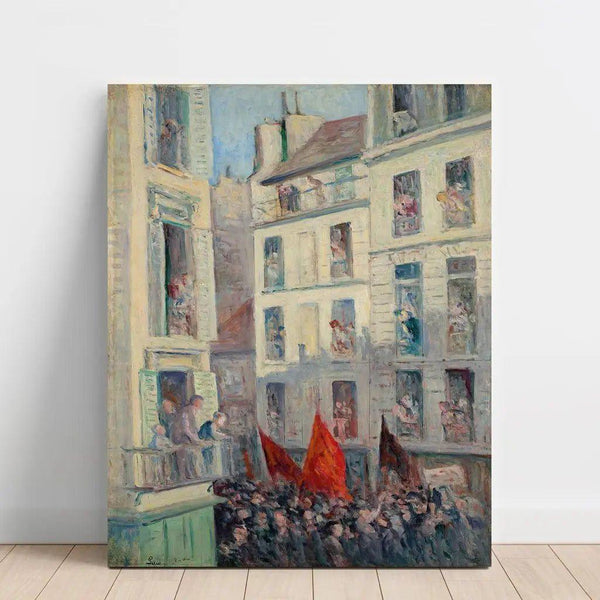
One cannot understand the art of Maximilien Luce without evoking his convictions. Close to libertarian circles, he shared with several Neo-Impressionists a social ideal that runs through much of his work. He contributed to committed publications and put his talent as an engraver at the service of the cause he defended, depicting the working-class condition and the realities of labour with a gravity free of complacency. In 1894, amid the climate of repression that struck anarchist circles, he even underwent a brief imprisonment, an episode that testifies to the sincerity of his commitment.

This human and political dimension is reflected in his choice of subjects. “The Construction Site” belongs to that vein in which the artist observes men at work, bodies in effort and the settings of construction, without ever lapsing into demonstrative illustration. Luce also painted industrial regions, blast furnaces and landscapes transformed by human activity, thereby bringing to Neo-Impressionism a social grounding that the technique, often deemed cold and cerebral, did not necessarily foreshadow. For him, light is not merely a matter of optics: it also illuminates a condition and a world.
Paris, Landscapes and Posterity
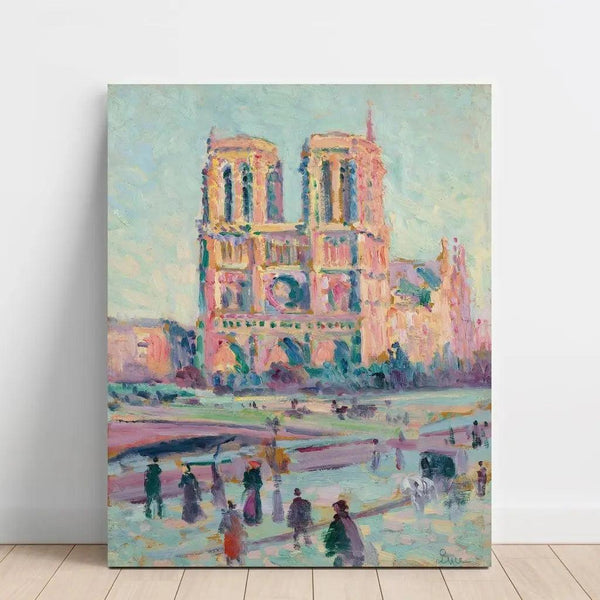
Among the motifs that recur in his work, the city of Paris holds a privileged place. Luce observed its quays, bridges and monuments with the curiosity of a stroller attentive to the variations of urban light. His view of “Notre-Dame de Paris”, of which a reproduction now exists, is part of this long acquaintance with the capital, where the Gothic edifice becomes a pretext for capturing the play of the atmosphere, the reflections on the Seine and the diffuse murmur of the city. These Parisian images extend the tradition of the painters who, throughout the nineteenth century, made the city a renewed subject of observation.

Throughout his career, Luce remained faithful to the Société des Artistes Indépendants, of which he was one of the leading members and which he presided over at the end of his life. This unbroken thread testifies to the constancy of a man who stayed attached to the values of artistic freedom that had governed the founding of the movement. Far from official honours, he continued to paint landscapes, scenes of labour and urban views with the same exactingness, pursuing a personal quest rather than worldly recognition.
To rediscover Maximilien Luce is to measure how much Neo-Impressionism was more than a mere matter of method. Through his canvases, the theory of colour is placed at the service of a sensitive gaze attentive to the world, where the beauty of landscapes never excludes consideration for those who inhabit and transform them. For the art lover, contemplating a faithful reproduction of his works, whether the rocks of Agay or Notre-Dame de Paris, offers a fitting way to reconnect with this patient, luminous and profoundly human painting.
Discover the full range of Maximilien Luce painting reproductions.