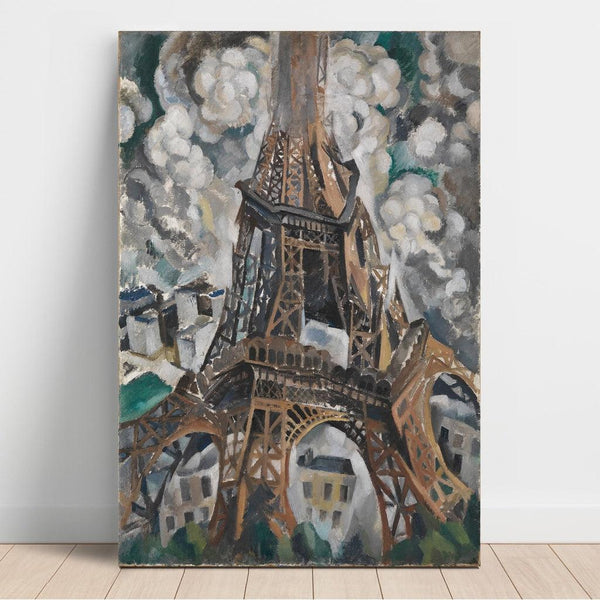
At the turn of the twentieth century, as Paris became the laboratory of every avant-garde, one painter made colour itself the subject of his painting. Robert Delaunay ranks among the figures who pushed modern art towards abstraction, tirelessly exploring light, movement and the correspondences between tones. Associated with Orphism, a movement he helped to define alongside his companion Sonia Delaunay, he left behind a body of work whose discs and coloured rhythms continue to shape the way we look at modernity. This journey offers a chance to revisit his path, his research and some of his most significant achievements.
Biographical landmarks of a Parisian painter
Robert Delaunay was born in Paris on 12 April 1885, into a milieu that brought him into contact with culture and the arts at an early age. His training did not follow the classic academic route: as a teenager, he worked in a theatre set design workshop, where he became familiar with colour applied on a large scale and with the effects of light. This hands-on experience, far removed from traditional fine-arts teaching, lastingly steered his sensibility towards chromatic material and visual construction.
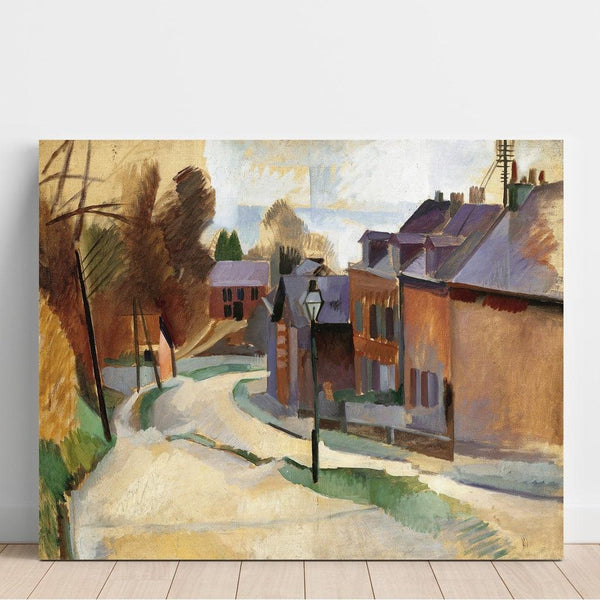
In the first years of the century, he absorbed the lessons of Post-Impressionism, particularly those of Neo-Impressionism and its breaking down of the coloured brushstroke. His meeting, around 1907, with the artist Sonia Terk marked a decisive turning point. The couple married in 1910 and formed one of the most fruitful partnerships in twentieth-century art: their research answered and nourished one another, both in painting and in the field of the applied arts. Together, they developed an aesthetic founded on pure colour and contrast, which would become the signature of their shared approach.

Orphism and colour as subject
Delaunay first trained through his contact with Cubism, from which he retained the will to reconstruct pictorial space. But where the Cubism of Picasso and Braque favoured a restrained palette and an analysis of volumes, Delaunay quickly took another direction: he placed colour at the centre of his research and made it the very engine of composition. This shift led to a language of his own, which the poet Guillaume Apollinaire christened "Orphism" around 1912, in reference to Orpheus and to the idea of a painting as immediate and sensory as music.
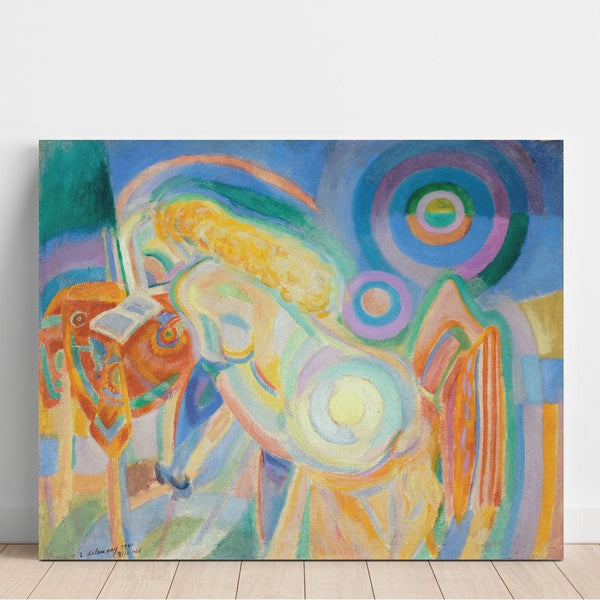
The principle governing this painting is that of simultaneity. Delaunay drew on the theories of the simultaneous contrast of colours, inherited notably from the work of the chemist Michel-Eugène Chevreul, to organise his canvases around the juxtaposition of tones that heighten one another. Colours no longer serve to describe an object or to imitate nature: through their relationships alone, they create depth, rhythm and movement. The circular form, the disc and the arc become the favoured vehicles of this dynamic, opening the way to an abstraction in which the subject merges with chromatic energy itself.

This contribution reached beyond the French context. Delaunay's research into colour found an echo among artists in Central Europe, particularly within the circle of Der Blaue Reiter in Munich, where his painting was regarded as a milestone towards an expression freed from imitation. Orphism thus appears as one of the links connecting Cubism to the more radical forms of non-figurative art.
Major works, from the city to modern speed
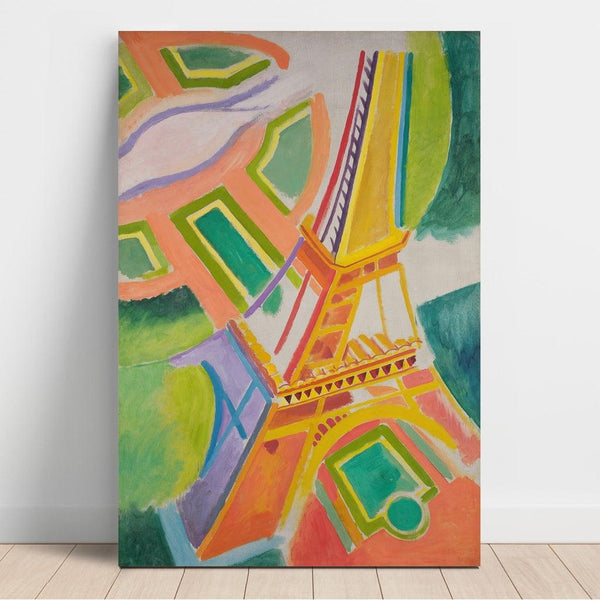
Delaunay's imagination was that of the modern city, its lights and its machines. The Eiffel Tower, a motif he returned to on numerous occasions, embodies this fascination with the technical monument and with the vertigo of the metropolis. He fragmented it, multiplied it and made it vibrate through colour, transforming a familiar silhouette into an unprecedented visual experience. The Windows series pursued this exploration: the urban scene dissolves into translucent coloured planes, where filtered light becomes the true subject of the painting.
_-_GMA_2942_-_National_Galleries_of_Scotland.jpg?width=1280)
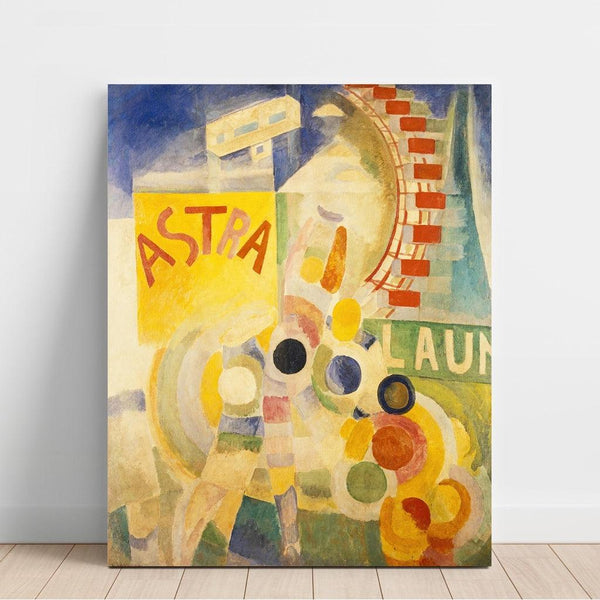
Among his most ambitious compositions is The Cardiff Team, in which Delaunay captures the energy of sport, advertising and modern spectacle in a single surge. The subject, borrowed from the news of the day, allowed him to combine figures in motion, signs and the emblems of contemporary life in a coloured orchestration that celebrates speed and the simultaneity of sensations. Other canvases, such as The Gypsy, testify to the diversity of his motifs and to his way of integrating the human figure into his research on colour and the construction of the plane. Through these works emerges a painter attentive to his era, determined to translate its tempo by strictly pictorial means.
Legacy and reproductions to discover
Delaunay's trajectory did not end with the pre-1914 avant-garde. The years of the First World War, spent largely on the Iberian Peninsula, extended his experiments with light and colour through contact with a new environment. Back in Paris, he took part in the debates on abstraction between the wars and returned to the vocabulary of circular forms and discs, which he varied in rhythmic compositions and large decorative ensembles. He died in Montpellier on 25 October 1941, leaving a body of work that has weighed lastingly on the history of colour in painting.

To take this discovery further, two reproductions offer a way to approach complementary facets of his art. The Painting Woman with a Parasol - Robert Delaunay | Reproduction points back to the figurative painting of his early years, where the human motif already lends itself to a reflection on brushstroke and colour. The Painting Disc Relief - Robert Delaunay | Reproduction, for its part, illustrates the abstract and circular side of his maturity, that of chromatic rhythms built around the disc. Brought together, these two images give a sense of the breadth of a painter who moved from depicting the city to the pure exaltation of colour.
To look at Delaunay today is to measure how much modernity needed artists capable of trusting their own means: colour, form, rhythm. Without resorting to anecdote or effect, he opened up a space where painting is sufficient unto itself. It is this clarity of intention, as much as the brilliance of his compositions, that explains the place he holds among the great names of modern art and the enduring interest his works arouse.
Discover the full range of Robert Delaunay painting reproductions.