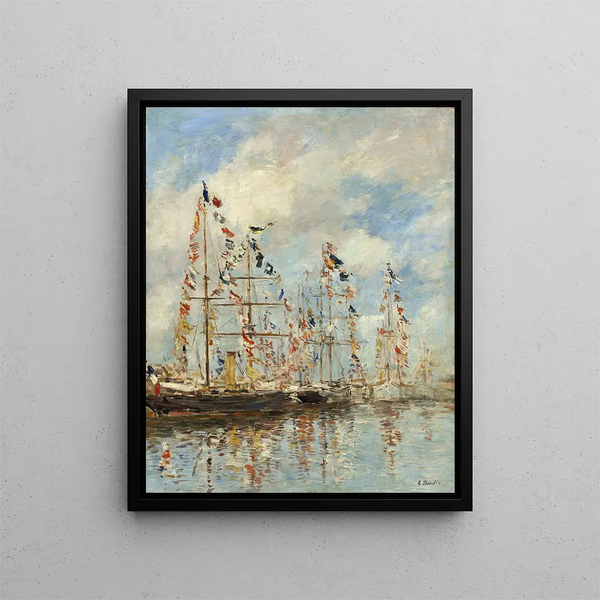
A painter of shifting skies and the shores of the English Channel, Eugène Boudin holds a singular place in nineteenth-century French painting. Born on 12 July 1824 in Honfleur, the son of a sailor, and dying on 8 August 1898 in Deauville, he devoted his entire life to the light of the Normandy coast. Corot is said to have nicknamed him the « king of skies », and Claude Monet, whom he introduced to open-air painting, acknowledged all his life how much that meeting had decided his vocation. Between the lesson of Corot and the flowering of Impressionism, Boudin traces a direct bridge, made of rapid brushstrokes, silvery greys and a constant attention to what, in a landscape, lasts only an instant.

From Le Havre to Paris: the shaping of an eye
Nothing destined the son of a Honfleur sailor for painting. Established in Le Havre as a stationer and framer, Boudin nonetheless made his shop a decisive place for his future: there he exhibited canvases by Millet, Troyon and Couture. These painters, noticing the young shopkeeper's attempts, encouraged him to persevere. The craftsman who framed the works of others then began to paint in turn, a patient observer of the harbour and the light of the estuary.
Recognition came first from his own town: in 1851, the municipal council of Le Havre granted him a scholarship to study in Paris. That a town council should support in this way a craftsman without academic training says a great deal about the conviction his earliest works already conveyed. The stay in Paris completed his apprenticeship, but the essence of his art played out elsewhere: on the beaches, jetties and estuaries of the Normandy coast, which he would roam his whole life, easel in hand.
The « king of skies » and the lesson given to Monet
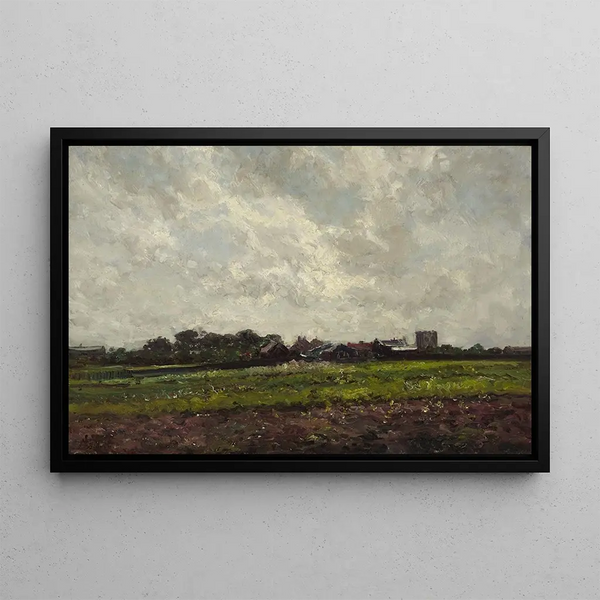
Corot is said to have nicknamed him the « king of skies », and the phrase sums up the essential. In Boudin's work, the sky is never a mere backdrop: it occupies an immense part of the canvas, crossed by moving clouds whose metamorphoses the painter watches for. His method is almost that of a scientific record: on the back of his studies, he notes the date, the hour and the wind. These precise meteorological notations explain the accuracy of his greys, his whites and his blues, which always refer back to a genuinely observed moment rather than to a studio convention.
Around 1857-1858, this rigour found an unexpected heir. In Le Havre, a teenager named Claude Monet was then making a name for himself through his caricatures. Boudin took him out to paint from nature and introduced him to open-air painting. The meeting was decisive, and Monet would acknowledge all his life what he owed to this elder who taught him to look at light above all else. The lineage was publicly sealed in 1874, when Boudin took part, at Nadar's, in the first Impressionist exhibition, alongside the generation he had helped to awaken.
Trouville and Deauville: the invention of the beach scene
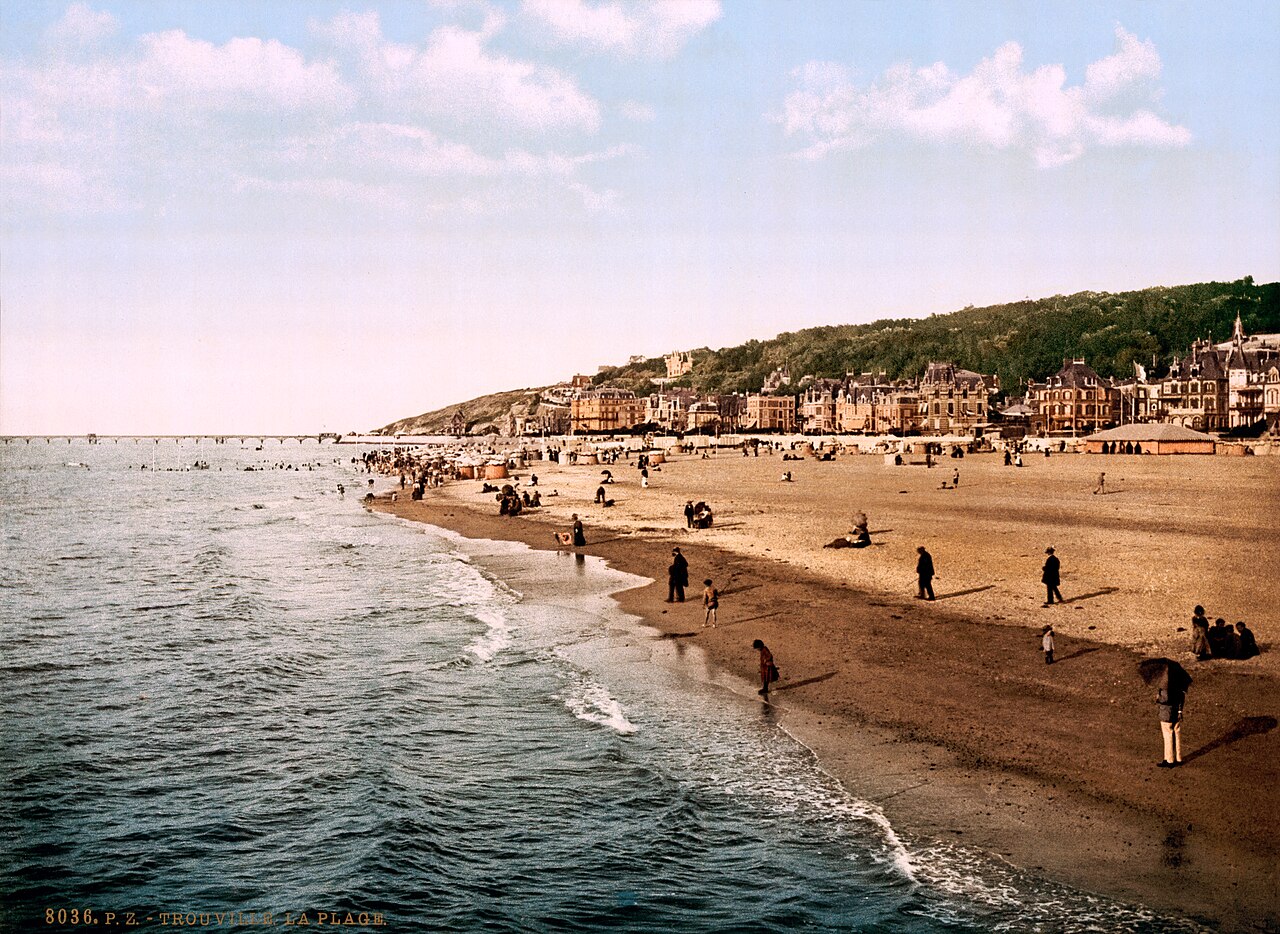
From 1862 onwards, Boudin devoted himself to the motif that would make his reputation: the beaches of Trouville and Deauville, where an elegant holiday crowd gathered. Crinolines, bathing cabins and parasols settle onto the canvas in small lively touches, without superfluous detail. The painter tells no anecdote: he records a moment of seaside life, a silhouette leaning forward, a group gathered facing the sea, and lets the light unify the whole. This gaze, at once attentive and discreet, makes him the chronicler of an elegance captured at the water's edge, without indulgence or caricature.
« The Beach at Trouville » (1888) offers the synthesis of these researches pursued over more than twenty-five years. The sky occupies most of the canvas, immense above a narrow band of sand; the figures, indicated in a few rapid accents, seem caught in passing; the silvery light of the Channel bathes the scene in a soft tone, without forced brilliance. The horizon, placed very low, yields the leading role to the sky, and it is the sky that gives the scene its mood. All of Boudin is there: the economy of means, the atmospheric accuracy, the refusal of the pose.
The same world reappears in « Trouville, The Nursemaid », where the presence of a nursemaid among the strollers recalls that these beaches were a social stage as much as a landscape. There Boudin observes the society of his time with that measured distance which gives his seaside scenes their value as testimony.
Harbours and estuaries: the other side of the work
Boudin is not only the painter of elegant women in crinolines. The son of a sailor, familiar with the quays since childhood, he devoted a considerable part of his work to harbours and estuaries. One measures this before « Le Havre, the Outer Harbour at Sunset » by Eugène Boudin: the painter finds again the town of his beginnings at the hour when the day declines, that turning point when the light changes from minute to minute — precisely what his rapid, accurate brushstroke knew how to fix.

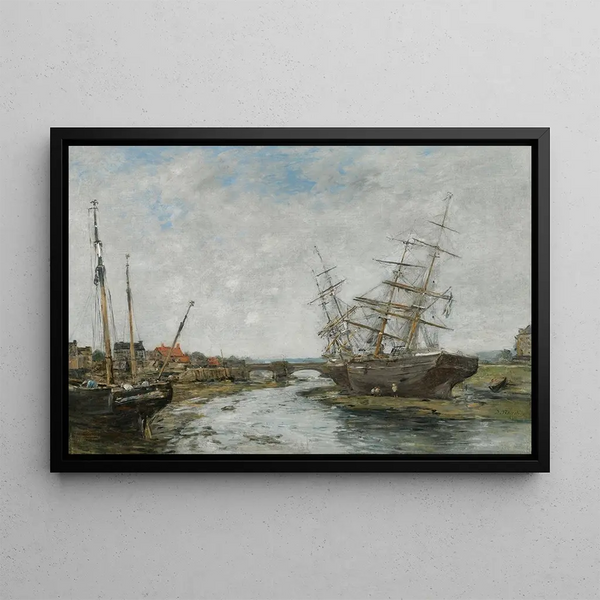
« The Touques at Low Tide » attests to the same taste for the transient states of the landscape: the ebbing tide uncovers the banks and imposes a provisional character on the motif, since a few hours later the same place will have changed its face. To paint at low tide is to accept that the motif slips away: a constraint that Boudin turns into a subject. « The Port of Trouville » completes this group by turning the gaze towards the boats and quays, captured with the same economy of brushstroke as the neighbouring beach scenes. These subjects speak of the coherence of a body of work entirely turned towards direct observation.
Travels, honours and final years
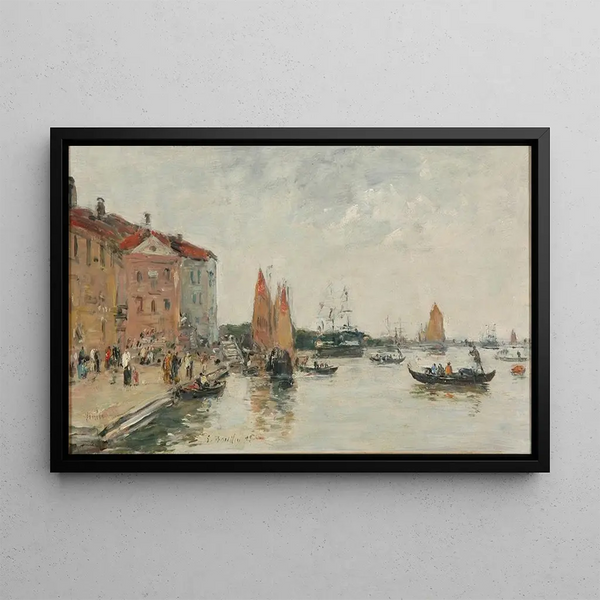
Though Normandy remained his anchor, Boudin travelled regularly: Brittany, Bordeaux, the Netherlands, the south of France, then Venice in the 1890s. On the Venetian lagoon as on the quays of Bordeaux, he found again what had always occupied him: the meeting of water and sky. These journeys broadened his palette without altering his method: everywhere, he sought first the sky, the water and the particular quality of the light of the place. In 1892, the Legion of Honour came to crown a career begun behind the counter of a Le Havre stationery shop. He died six years later at Deauville, on the shore of that Channel he had never ceased to paint.
His legacy can be summed up in a few words: a silvery, golden range, a rapid and accurate brushstroke, a keen sense of the fleeting. The history of painting places him as a direct bridge between Corot and Impressionism — not a theorist, but a transmitter, the one who showed the next generation that a picture could be born outdoors, before the motif, in the very time of observation.
Seascapes in an interior: formats and hanging
Boudin's works fit naturally into today's interiors. Their light, silvery and golden range brings brightness to a room without ever overwhelming it; their immense skies open up the space in the manner of a window. The reproductions of paintings by Eugène Boudin thus suit living rooms as well as more intimate spaces: a beach scene above a console table, a harbour at sunset in a study, a riverbank at low tide in a bedroom with natural tones.
The choice of format deserves attention. A medium format preserves the delicacy of the figures and lends itself to hanging at eye level, in a hallway or above a low piece of furniture; a large format restores the breadth of the skies and calls for a clear wall, preferably facing a source of natural light. A restrained frame — a slim moulding, light wood or matt black — respects the restraint of the palette and lets the sky breathe. In an entrance hall, a series of two or three seascapes of identical format moreover sets up a regular rhythm, close to that of a gallery picture rail.
These seascapes finally dialogue effortlessly with other Impressionist paintings: hung side by side, they form a coherent ensemble around the light of the closing nineteenth century. The lesson of the « king of skies » holds good for an interior too: few effects, a truthful light, and a gaze that returns without tiring.