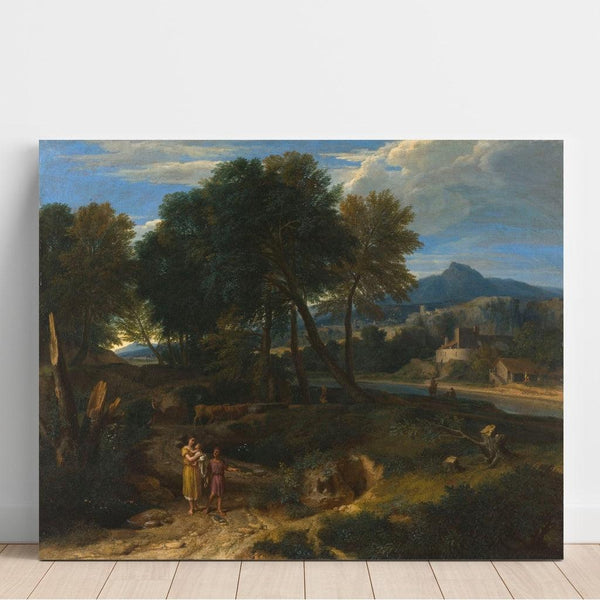
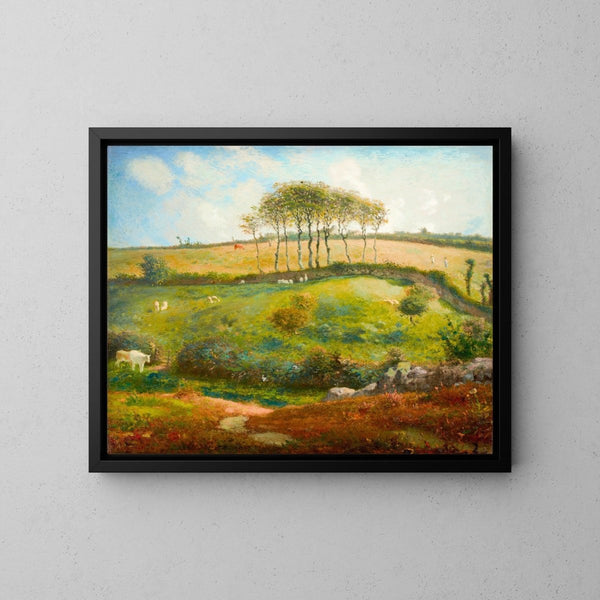
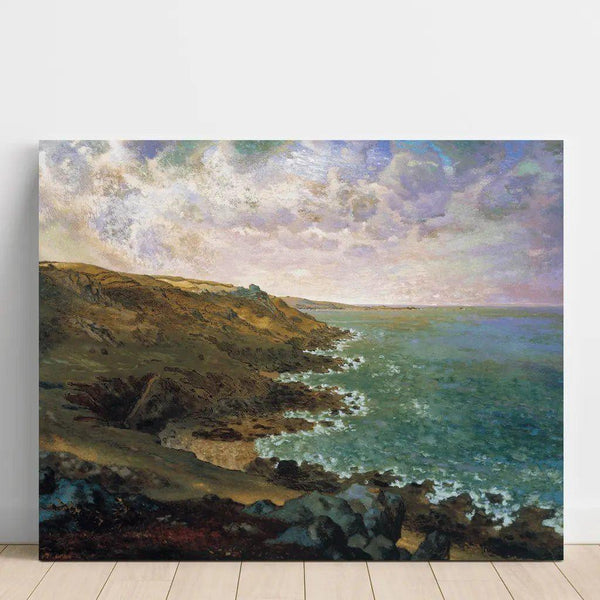
A painter of fieldwork and peasant dignity, Jean-François Millet holds a singular place in the history of nineteenth-century French art. A leading figure of the Barbizon school, he brought into painting scenes that the official art of his time judged unworthy of the grand genre: gleaning, tending flocks, the return home from work at nightfall. Far from anecdotal picturesqueness, his work lends the humblest of gestures an almost monumental gravity. This journey, from rural Normandy to the forests of Fontainebleau, traces that of an artist faithful to his origins and attentive to the deeply human quality that ordinary life conceals.
From Norman roots to the Parisian studio
Jean-François Millet was born on 4 October 1814 in Gruchy, a hamlet on the Cotentin peninsula in Normandy. Raised in a family of farmers, he grew up in direct contact with agricultural labour and the coastal landscapes that would leave a lasting mark on his eye. This rural childhood was no mere decorative memory: it formed the bedrock of a sensibility that, throughout his career, would draw the artist back to the figures of the peasant world.
His vocation took shape in Cherbourg, where he received his first training under local painters. He then went to Paris to further his apprenticeship and to measure himself against the masters and institutions of his era. The capital offered him access to collections, studios and artistic life, yet Millet kept his distance there: the subjects that drew him were not those favoured at the time by academic history painting. His early years saw him explore several registers, from portraiture to genre scenes, before the path that would make his name asserted itself.

Peasant realism and the Barbizon school
It was by settling in Barbizon, on the edge of the Fontainebleau forest, that Millet fully found his field of expression. There he joined the circle of painters gathered around this village, drawn by nature and by direct observation of the real, who would form what came to be called the Barbizon school. In this setting, Millet developed a personal manner in which the landscape is never separated from those who inhabit and work it.
His realism stands out for its constant attention to the truth of gesture and posture. Bodies bend under exertion, silhouettes stand out against the horizon, faces often remain barely detailed, as if to let the whole attitude carry the expression rather than the line. This economy of means produces an impression of solemnity: the everyday scene acquires a resonance that exceeds the moment depicted. Millet seeks neither to idealise the peasant condition nor to burden it with demonstrative pathos; he offers it to view with a sobriety that is, precisely, its strength.
.jpg?width=1280)
This choice was far from self-evident in the artistic context of the mid-nineteenth century. By placing at the centre of the canvas field workers treated with the seriousness once reserved for noble subjects, Millet took part in the renewal of painting's themes. His work thus engages with the great debates of his time on realism, while retaining a meditative tone that is entirely his own.
Emblematic works
Among the canvases that carried Millet's fame, The Angelus, painted between 1857 and 1859, holds a place apart. Two peasants, a man and a woman, pause from their work in a field to gather in prayer at the hour of the evening bell, while the church steeple can be made out in the distance. The composition, spare and frontal, concentrates all attention on this suspended moment. The work has become one of the most recognisable images in French painting, a symbol of a simple piety and of an intimate bond between labour, the land and passing time.
_-_Peasant-Girls_with_Brushwood_-_WGA15690.jpg?width=1280)
The same year, The Gleaners (1857) brings together three women bent toward the ground to gather the ears of grain left after the harvest. The repeated gesture of gleaning, hard and patient, speaks of the precariousness of a rural economy in which nothing goes to waste. Millet makes of it an image of great dignity, in which the humility of the task rises to the measure of a rigorous composition. Alongside these major works, other canvases attest to the variety of his inspiration: the Seated Shepherdess, meditative in the solitude of the fields, or The Faggot Gatherers, which stages the effort and burden of gathered wood.
Millet's world, however, is not confined to rural scenes alone. He also took up subjects drawn from literature and tradition, as Daphnis and Chloe attests, inspired by the ancient pastoral tale. This foray is a reminder that the painter, for all his attachment to the peasant world, belonged to a broad culture and knew how to summon other registers. It also sheds light on the pastoral dimension, in the full sense of the term, that runs through his entire body of work: that of an art of the countryside and the seasons, between observation and evocation.
A lasting legacy
_-_Google_Art_Project.jpg?width=1280)
Jean-François Millet died on 20 January 1875 in Barbizon, leaving a body of work whose influence extended well beyond his passing. His view of peasant life, his way of monumentalising the ordinary gesture and his sense of rural light left their mark on the generations that followed. Painters attentive to the truth of labour and to the presence of landscape recognised in him a forerunner, and his name remains associated with a turning point in how subjects worthy of being painted were regarded.
Even today, his compositions retain an undiminished force. The sobriety of his framing, the balance of his masses and the restraint of his figures continue to move a wide audience, far beyond specialist circles. To contemplate a canvas by Millet is to recover the feeling of time attuned to the rhythms of the land, and the conviction that a modest scene can carry within it a share of the universal.
For those who wish to bring this legacy into their home, the reproduction of Jean-François Millet's painting The Angelus offers direct access to one of the most emblematic images in French painting. It lets you rediscover, in the intimacy of an interior, the evening light and the silent contemplation that made this work famous, and so to prolong the dialogue with an artist whose view of the rural world has lost none of its truth.
Discover the full range of Jean-François Millet painting reproductions.