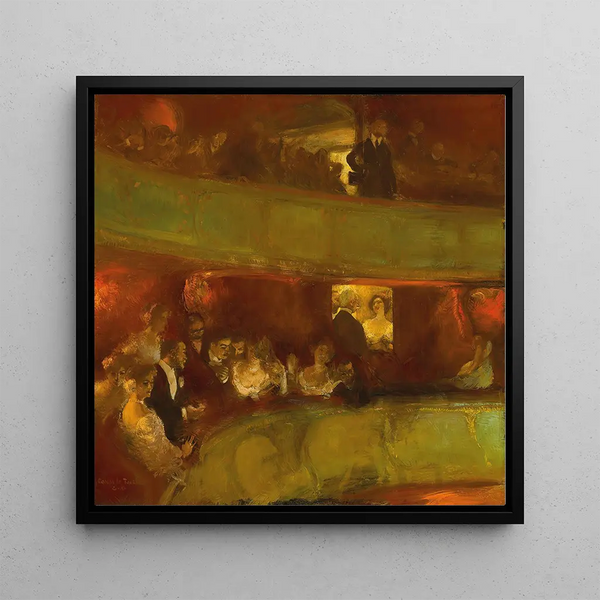
Among the figures who bridge the passage from the nineteenth to the twentieth century, Gaston La Touche holds a singular place. A French painter, engraver and illustrator, born in Saint-Cloud in 1854 and died in Paris in 1913, he embodies a rare trajectory: that of an artist who set out from the sombre tones of naturalism to arrive at a painting radiant with light and colour, nourished by the memory of the eighteenth century. His work, prized today by lovers of the Belle Époque, appeals through its decorative freedom and its sense of enchantment. For anyone wishing to understand how a single artist could reinvent his manner over the course of a career, La Touche offers an example that is at once cultivated and accessible.
A path between naturalism and enchantment
Gaston La Touche trained largely as a self-taught artist, without following the long academic curriculum that then structured most careers. In his early years, he moved within the orbit of naturalism and the painting of modern life, for which Édouard Manet remained the guiding reference. This first period favoured contemporary subjects and a darkened palette, in keeping with the social and realist concerns of the age. Here the artist showed himself attentive to scenes of everyday life and to the documentary dimension of his gaze.
La Touche also frequented the naturalist literary circles, close to Émile Zola and to the writers who made the observation of reality an aesthetic programme. Like many artists of his generation, he practised illustration, a then-flourishing discipline that allowed images to be widely disseminated and to enter into dialogue with the text. This graphic activity, pursued alongside his painting, sustained in him an ease of composition and a sense of visual narrative that would leave a lasting mark on his manner.

The conversion to light
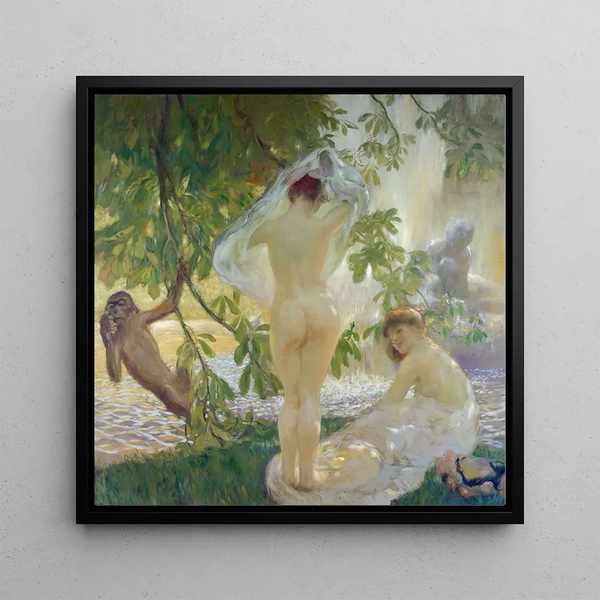
The turning point of his career lies in a decisive change of vision. Encouraged by the engraver Félix Bracquemond, an important figure in the revival of the decorative arts, La Touche gradually abandoned the sombre tones of his beginnings to turn towards a bright, colourful and vibrant painting. This evolution brought him closer to his generation's explorations of light and colour, without his adhering strictly to Impressionism: his brushwork remained in the service of a decorative imagination and an atmosphere rather than of a mere optical notation.
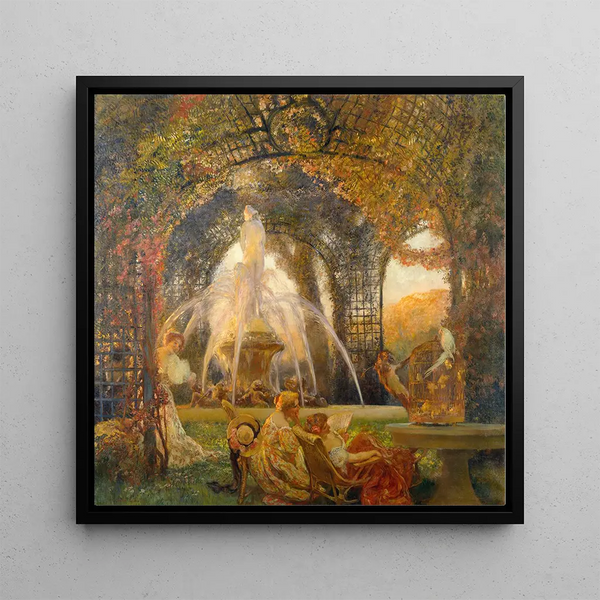
From then on, water, reflections and the play of light became favoured motifs. Fountains and pools, in particular, gave him the occasion to study the way brightness is refracted across a moving surface. A canvas such as A Water Fountain in the Tuileries attests to this taste for scenes of gardens and parks where architecture, vegetation and water compose a setting conducive to luminous effects. There La Touche deploys a sensitivity to shimmer that becomes the signature of his maturity.

This attention to light is not merely a matter of technical virtuosity. It conveys a conception of painting as enchantment, in which the viewer is invited to perceive the world in an idealised light. The reproductions offered today, such as The Letter, extend this intimate and refined vein, in which a suspended moment is clothed in a soft and enveloping brightness.
Fêtes galantes and the legacy of the eighteenth century
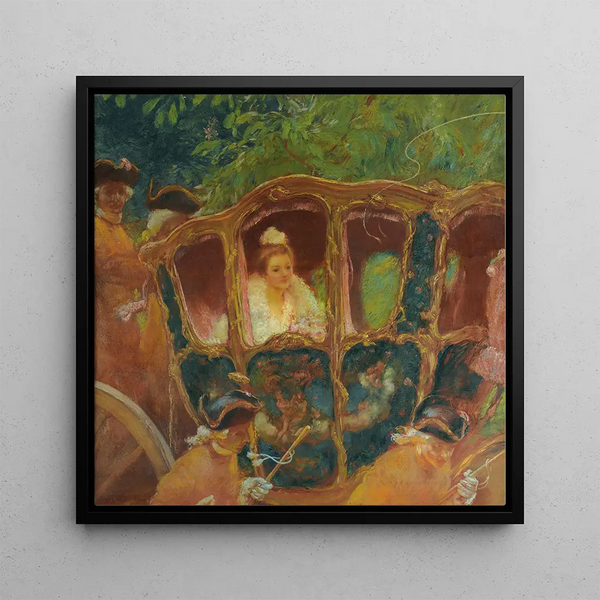
The second part of La Touche's career is inseparable from his dialogue with French painting of the eighteenth century. The painter takes his place within the great movement rediscovering that age of artistic enlightenment which ran through the end of the nineteenth century, at a time when connoisseurs and critics were reassessing the legacy of Watteau, of Fragonard and of the tradition of the fêtes galantes. La Touche reconnects with this repertoire of gardens, balls, scenes of pleasure and elegant conversations, which he reinterprets with a wholly personal freedom.

His compositions readily stage graceful figures moving through parks or beneath foliage, in an atmosphere of festivity and carefree ease. A work such as The Arbor, whose title evokes the bower and the leafy retreat, illustrates this taste for intimate settings where nature becomes a jewel case. Likewise, the reproduction entitled The Joyous Festival harks back to this world of merrymaking where colour and movement express an unabashed joy of living. La Touche does not seek to copy the eighteenth century: he captures its spirit in order to transpose it into the pictorial language of his own time.
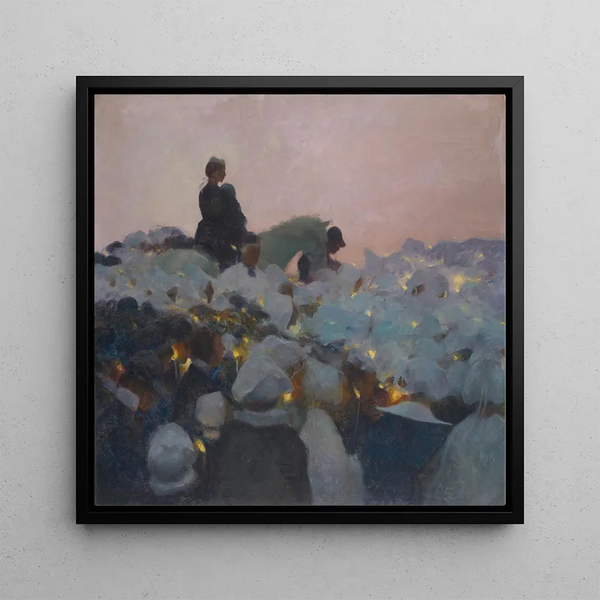
This avowed kinship with the rococo tradition explains in part the success of his work with a public sensitive to the charm of the Belle Époque. Far from any sterile nostalgia, La Touche makes this heritage a point of departure for a modern decorative painting, in which ornament and narration are combined. Night scenes, illuminations and fireworks number among the subjects that allow him to push this poetry of artificial light the furthest.
The decorator and his legacy

Gaston La Touche did not confine himself to the easel painting. His sense of ample composition and his taste for colour naturally drew him towards the decorative arts and large painted ensembles. At a time when the ornamentation of public and private buildings engaged many artists, he placed his talent in the service of panels and decorative schemes intended to enliven interiors. This monumental dimension extends the logic of his work: to make painting an environment, an atmosphere in which the gaze can unfold.
Recognised in his lifetime, La Touche exhibited regularly at the great Parisian artistic gatherings and belonged to the circles that then shaped the life of the arts. His participation in the Salons and his closeness to the Société Nationale des Beaux-Arts attest to a solid standing within the official milieu, while retaining a personal manner that set him apart from his most academic contemporaries. His painting, by turns intimate and sumptuous, was able to answer the taste of a public in search of refinement and escape.
Today, the work of Gaston La Touche is being rediscovered amid the renewed interest in the painting of the Belle Époque and in the artists who bridged the waning nineteenth century and the nascent modern age. His luminous gardens, his fêtes galantes and his intimate scenes retain a freshness that explains their continued presence in collections and on the art-reproduction market. For the curious enthusiast, he offers the example of a painter who, without breaking with tradition, was able to instil in it a new and enduring light.
Discover the full range of Gaston La Touche painting reproductions.