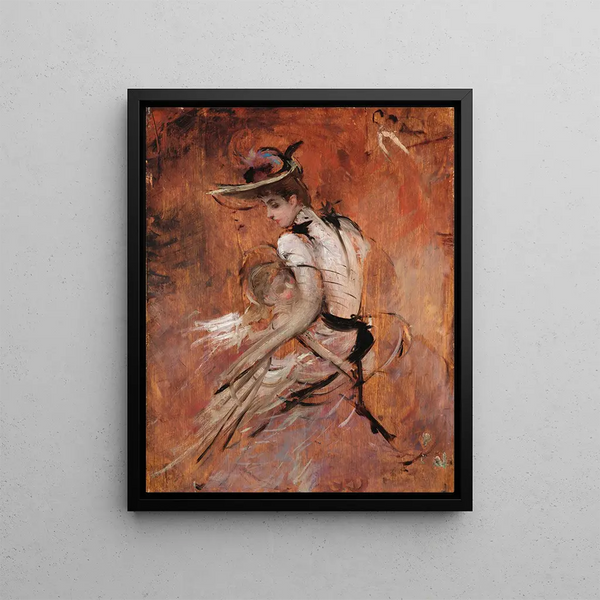
Born on 31 December 1842 in Ferrara, the son of a painter, Giovanni Boldini belongs to that generation of Italian artists who made Paris their true studio. Trained in Florence and close to the Macchiaioli, he moved to London in the early 1870s before settling in the French capital around 1871-1872. There, alongside John Singer Sargent, he became one of the great society portraitists of the Belle Epoque. His swift, undulating brushwork, which earned him the nickname "Master of Swish", imposes slender silhouettes, a keen sense of movement and dazzling fabrics. He died in Paris on 11 January 1931, leaving behind a body of work in which elegance is matched by a rare pictorial energy.

An Italian in Paris, from Florence to the salons
Boldini's path mirrors that of a European art in full transformation. In Florence, during his formative years, he mixed with the Macchiaioli, those painters who favoured the patch of colour, the sharp contrast of light and shadow, the direct capture of the subject. This school taught him to look quickly and to paint without heaviness, to convey an impression before it could set. His stay in London in the early 1870s then brought him into contact with a wealthy clientele and with the portrait genre, where he cut his teeth.
His move to Paris, around 1871-1872, was decisive. The city then concentrated commissions, models and the stimulating rivalry of the studios. Boldini found there the ideal ground for a talent that nothing seemed able to contain. He did not arrive on conquered territory: he first had to make a name, a reputation, a manner unmistakably his own. It was in Paris that he gradually forged that style of speed and undulation which would become his signature, and it was there that he would cross paths with the most prominent figures of his time.
The portraitist of the Belle Epoque
What sets Boldini apart is a conception of the portrait as a portrait in motion. Where others seek the stable pose, he chases the instant when the body unfurls, when a hand rises, when a fabric slips. The brushstroke races, stretches, arches; the drapery seems run through by a current. The nickname "Master of Swish", master of the swirl of fabric, says enough about this virtuosity of painted matter, which gives his canvases their so particular vibration. The silhouettes lengthen, grow finer, gain in verticality and in grace.

This manner finds its emblem in "Count Robert de Montesquiou" (1897, Musee d'Orsay). The sitter appears there as a consummate dandy, the embodiment of an elegance calculated down to the smallest detail. This dandy inspired Marcel Proust's character of the Baron de Charlus: Boldini's portrait thus fixes, in a single image, an entire facet of the sensibility of the century's end. The palette, gathered on deep blacks and a few bright accents, concentrates attention on the gesture and the gaze.
Boldini's circle of models reads like a directory of the Belle Epoque. He painted Cleo de Merode, the Marchesa Casati, and Whistler. In 1886 he also made, in pastel, a portrait of Giuseppe Verdi, captured with an economy of means that contrasts with the splendour of his great commissioned canvases. This diversity shows an artist capable of adapting his touch to each person's presence, without ever giving up his own vivacity.
From the streets of Paris to intimate figures
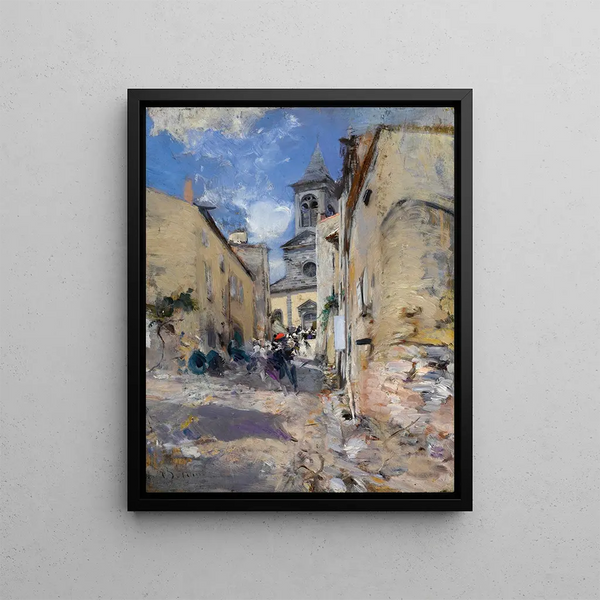
Before becoming the appointed painter of the salons, Boldini had honed his skills on more modest subjects. In his early days, he produced many genre scenes and views of Parisian streets and parks, where his sense of framing and his taste for movement were already at work. These more intimate compositions, less spectacular than the portraits of his maturity, reveal an essential facet of his art: attention to ordinary life, to passers-by, to the light of a walkway. In them one senses the eye trained among the Macchiaioli, alert to the patch of colour and to atmosphere.
It is in this vein that "The Musician" belongs, of which Artem Legrand offers a reproduction. The work shifts attention from the world of the salons to a figure caught in his activity, absorbed by his instrument. The brushwork keeps all its nervousness, but is placed at the service of a contemplative scene rather than a display of prestige. One measures thus how much Boldini's speed is not a mere effect: it serves the worldly brilliance as well as the quiet of a musical moment. Those who wish to discover this canvas can admire the reproduction titled The Musician.
The female portrait, for its part, remains the domain where the painter gives his full measure. "Portrait of Mademoiselle Emilienne Le Roy" offers a fine example. The sitter is treated with that slender elegance which characterises Boldini, the silhouette gaining in refinement through the effect of an elongated brushstroke and skilfully animated fabrics. The face, poised and attentive, contrasts with the quiver of the painted matter around it. The reproduction offered under the title Portrait of Mademoiselle Emilienne Le Roy lets one recapture this tension between the stability of the gaze and the vibration of the surface, which is the worth of his finest works.

A brushstroke, a palette, a manner
To understand Boldini, one must return to what gives his work its unity beyond the diversity of subjects. His brushstroke, first of all: rapid, undulating, never laboured, it leaves the eye the visible trace of the gesture. His blacks, next, deep and nuanced, which structure so many compositions and bring out the flesh of faces or the sheen of a bright fabric. His mastery of fabrics, finally — silks, satins and drapery that he makes ripple as if under a breath. This manner, entirely turned towards movement, explains the lasting modernity of a painter nonetheless attached to the codes of the society portrait. Nothing in his work is static: the painting seems caught in a single impulse, from the background to the figures.
Bringing Boldini to life in an interior
Boldini's works lend themselves naturally to the life of an interior, provided their breath is respected. A reproduction such as "The Musician" or a female portrait calls for a wall that gives it air: it is better to avoid clutter around it and to favour a relatively plain surface, where the silhouette and the movement of the fabrics can breathe. A vertical format, frequent with the painter, sits well on a narrow stretch of wall, between two windows or above a console, where the composition's slenderness finds an architectural echo.
Light plays a decisive role here. Boldini's deep blacks and bright accents benefit from being lit by a soft light, preferably lateral, which reveals the nuances of the matter without crushing the contrasts. A light that is too frontal would flatten the vibration of the brushstroke; a filtered natural light, or a directed point of light, on the contrary restores all the depth of the fabrics. In a living room of neutral tones, such a work becomes an anchor for the eye; in a more colourful room, it converses with the surrounding hues, provided it is given space to breathe.
Bringing together several subjects by the same artist, a portrait and a genre scene for example, allows one to compose a coherent ensemble that tells the twofold face of his work, worldly and intimate. To extend this discovery and compare the formats, one may browse all the reproductions of paintings by Giovanni Boldini and choose those that best suit the light and the spirit of a place. Hung in this way, these images retain something of the energy that ran through the painter's hand, and recall, in the calm of an interior, the vivid elegance of the Belle Epoque.