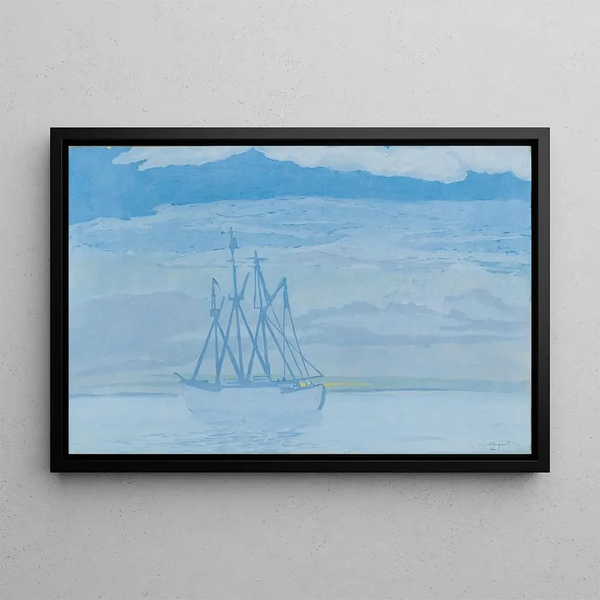
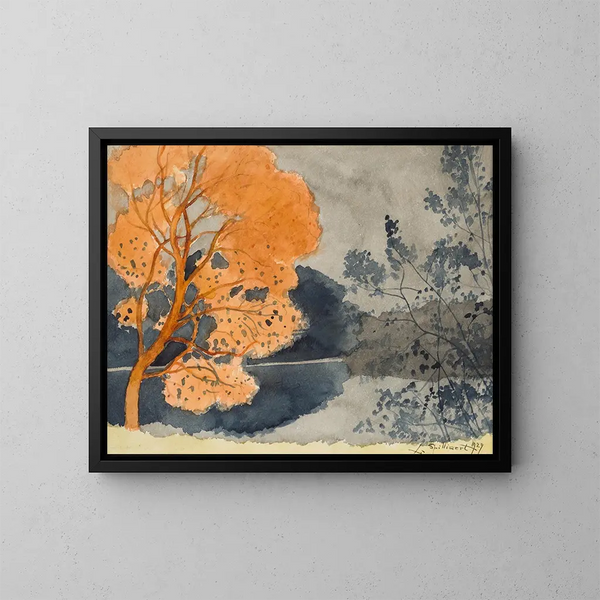
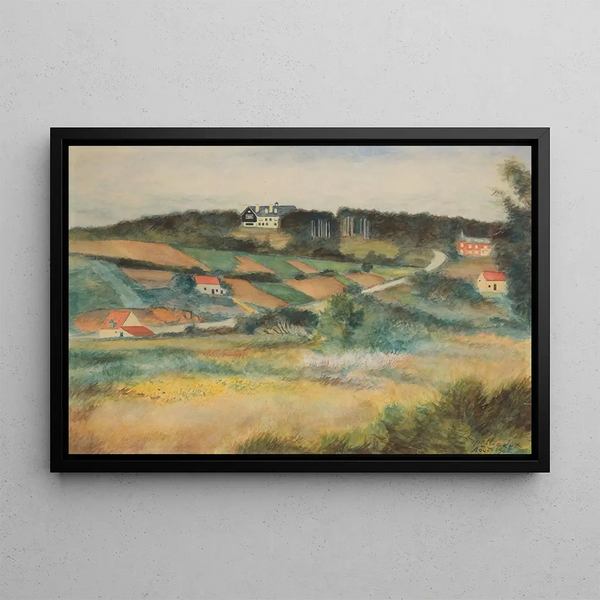
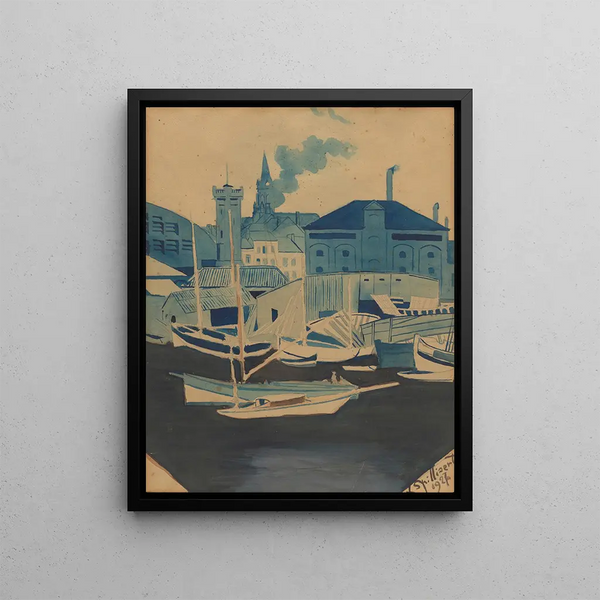
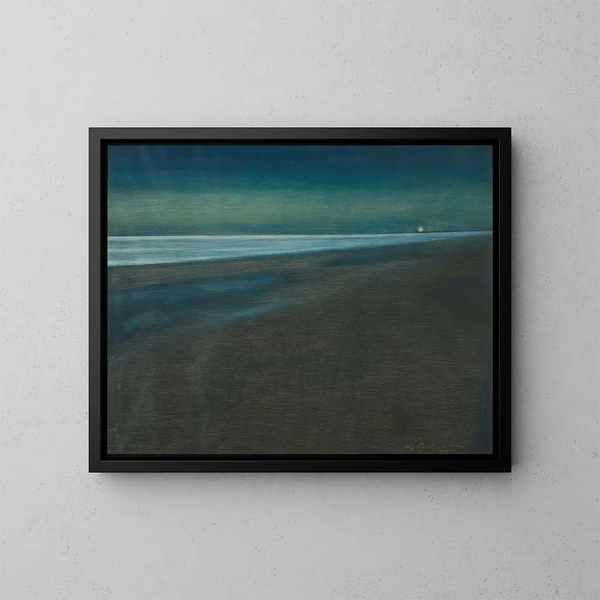
Born on 28 July 1881 in Ostend and died on 23 November 1946 in Brussels, Léon Spilliaert holds a singular place in Belgian art of the early twentieth century. The son of an Ostend perfumer and largely self-taught, he followed no academic path and joined no established movement. From this freedom emerged a body of work recognisable among all others: nocturnal seascapes, deserted sea walls, solitary street lamps and haunted self-portraits, captured in a light that seems to come from within. His sensibility, at once symbolist and pre-expressionist, makes him one of the great solitary figures of modern painting, whose intensity still speaks to lovers of art and decoration alike.

This world can be rediscovered today through the reproductions of Léon Spilliaert's paintings, which restore the delicacy of his papers and the depth of his blacks.
A child of Ostend, between the sea and insomnia
With Spilliaert, everything leads back to Ostend. The North Sea port town, its beaches, its long sea wall and its seafront form the haunting backdrop of his work. The artist suffered early on from fragile health: chronic insomnia, persistent stomach pains. From these sleepless nights he made an artistic material. He walked alone along the sea wall and the seafront, when the seaside resort was emptied of its strollers, and brought back from these nocturnal wanderings visions of emptiness, silence and waiting.
This experience of the night largely explains the tone of his painting. The broad dark expanses, the perspectives that flee towards an uncertain horizon, the wet surfaces reflecting the light of the street lamps: all of this comes from a direct, almost physical observation of the deserted shore. Spilliaert does not seek the picturesque of the traditional seascape, with its boats and lively skies. He renders an inner state — solitude, insomnia, muffled anguish — through a real landscape, that of his native town, which he never ceased to pace. The sea, for him, is almost never storm or spectacle: it is a motionless expanse, a dark mass that borders the void and prolongs the silence of the walk.
A technique of paper rather than oil

Spilliaert's singularity also lies in his means. Where so many painters of his time worked on canvas, he favoured paper almost exclusively. His preferred tools were Indian ink wash, watercolour, gouache, pastel and coloured pencils; he turned only very rarely to oil. This choice is by no means incidental: it determines the very look of his images.
Indian ink, spread as a wash, allowed him to achieve velvety blacks and nuanced greys, passages of shadow where form dissolves. Gouache and pastel bring muted mattes, surfaces without gloss that absorb light instead of reflecting it. The coloured pencil, used with restraint, introduces here a cold tint, there a discreet glow. This economy of means produces a tightened palette — deep blacks, nocturnal blues, pale ochres, the whites of the paper — that gives the whole body of work its unity and gravity. The stroke often becomes fluid and continuous, following the lines of the perspectives and the curve of the reflections.
This work on paper brings Spilliaert as close to drawing as to painting. He briefly frequented the Brussels publisher Edmond Deman, and moved within the symbolist milieu, producing illustrations in the circle of writers such as Maurice Maeterlinck and Émile Verhaeren. From this closeness to symbolist literature, his art retained a taste for silence, for suggestion, for atmosphere rather than narrative.
Vertigo and the sea wall: two visions of the night
Two works sum up the power of this world. The first, "Vertigo", stages one of the artist's most characteristic motifs: dizzying perspective. A staircase, a railing, a composition that tips over and draws the eye downward — here Spilliaert constructs space as a possible fall. The sense of imbalance arises from the very geometry of the image, from the accelerated flight of the lines and the contrast between the bright areas and the chasms of shadow. It is not a setting: it is a sensation, that of the ground giving way, translated into forms and values. The detail can be observed in the reproduction of Vertigo.
The second, "Ostend Sea Wall with Street Lamps", belongs to the great vein of nocturnal seascapes. The sea wall stretches out, deserted, punctuated by the alignment of street lamps whose light falls on the damp ground. The empty promenade, the low horizon, the rhythmic repetition of the lamps: everything contributes to an impression of inhabited solitude. The artificial light, isolated in the night, becomes the only landmark, almost a presence. This work converses with the famous "Sea Wall at Night", dated 1908, in which Spilliaert had already fixed this poetry of the nocturnal seafront. The reproduction of the Ostend Sea Wall with Street Lamps allows one to appreciate its balance of blacks and glimmers.

The self-portraits and the evolution of a body of work
Before painting the night outside, Spilliaert had probed the night within. His self-portraits of 1907-1908 are among the most powerful images of his entire career. Captured in the mirror, often at night, his face drawn, his gaze fixed, the artist depicts himself as a haunted figure of rare existential intensity. These are not exercises in likeness but confrontations: the insomniac man facing himself, in the silence of the sleeping house. Light sculpts the face, shadow hollows the eye sockets, and the whole attains a psychological truth that heralds expressionism without ever adopting its excesses.
This taut and anxious vein would not last forever. After the 1920s, Spilliaert's work grew calmer. The nocturnal sea and sea wall gradually gave way to other motifs: trees, forests, a quieter nature, observed with an almost meditative attention. The palette relaxes, the anguish unravels. This second manner, less known than the Ostend nights, testifies to an artist who passed through his obsessions to reach a more serene side of his art. The unity nevertheless remains: everywhere, the same economy of means, the same sense of silence, the same way of letting the paper breathe.
Living with a Spilliaert work
To welcome a Spilliaert reproduction into your home is to introduce a note of calm and depth. His compositions, built on broad dark expanses and a few luminous accents, sit naturally with restrained interiors, with pale walls as well as more muted tones. A grey, taupe or midnight-blue wall brings out the density of his blacks; a white wall, by contrast, lets the areas of paper breathe and underlines the graphic quality of the perspectives.
Seascapes such as "Ostend Sea Wall with Street Lamps", with their horizontality, find their place above a sofa, a console or a headboard, where they extend the gaze. Vertical compositions such as "Vertigo" suit narrow sections of wall, in an entrance hall, a stairwell or a corridor, where their dynamism finds an architectural echo. Light matters: these works born of the night cope poorly with direct glare and gain from soft, grazing lighting that respects their nuances. A gentle light, at the end of the day, reveals the subtlety of their greys and the presence of the street lamps. Hung in this way, Spilliaert's images do not merely decorate a wall: they install an atmosphere, that of silent walks along the shore of the North Sea.