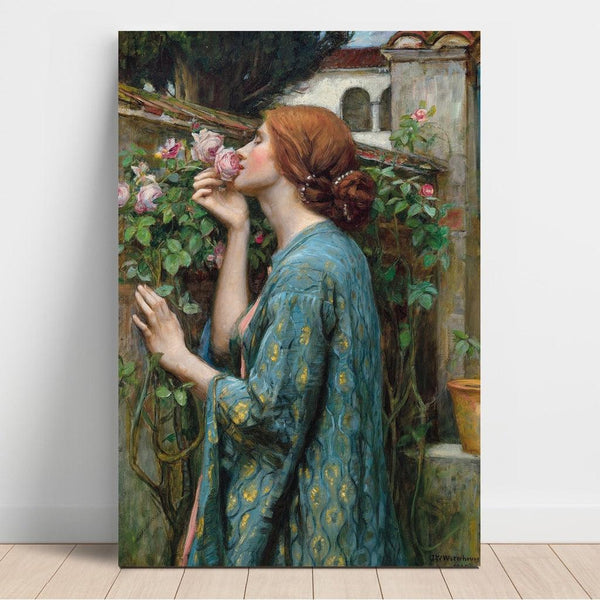
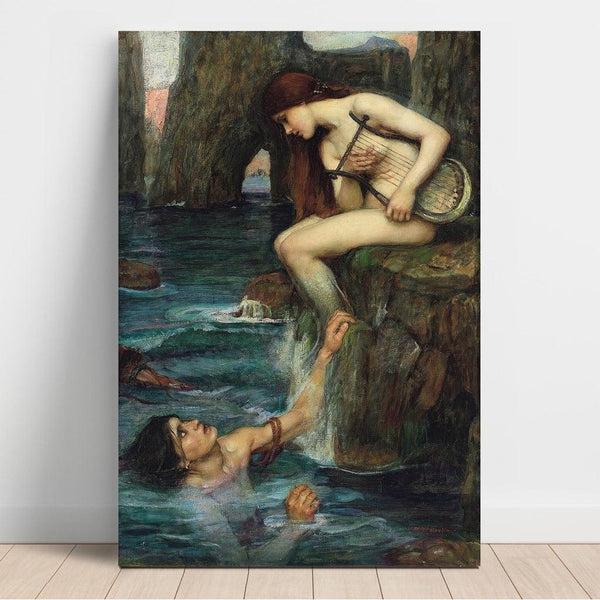
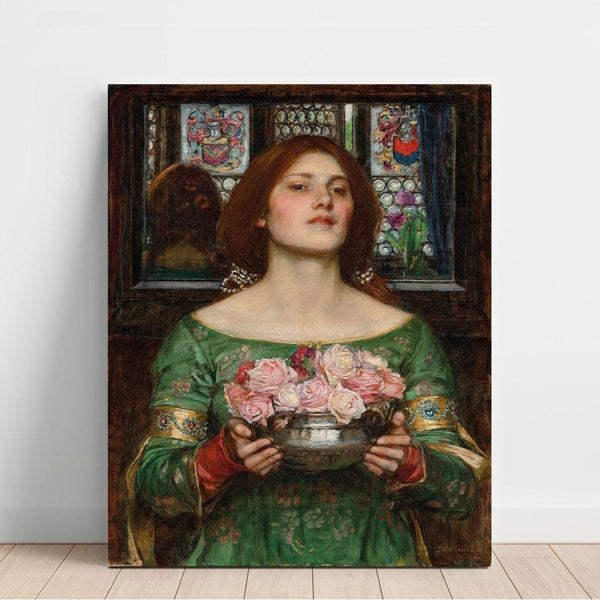
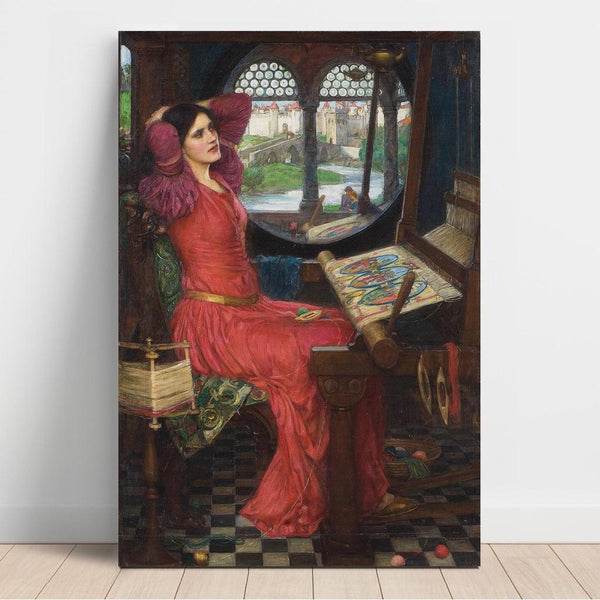
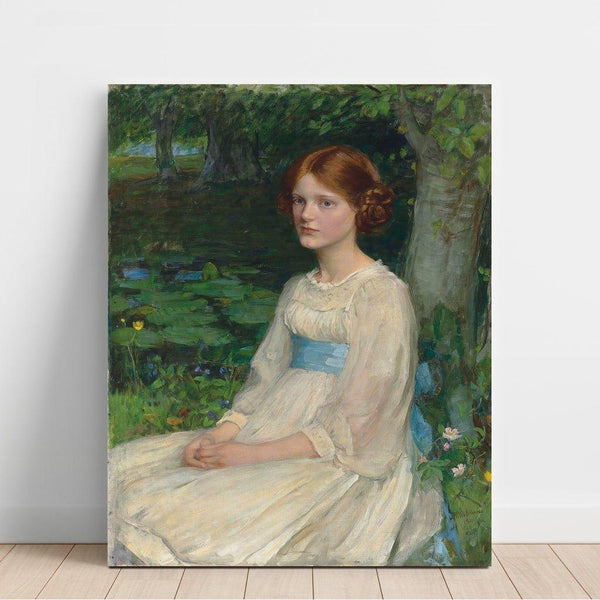
A British painter of the second half of the 19th century, John William Waterhouse holds a singular place in the history of art. Heir to the great academic tradition while remaining close to the Pre-Raphaelite sensibility, he devoted his work to the figures of ancient mythology, poetry and legend. His canvases, peopled with dreamy heroines and creatures drawn from ancient tales, continue to captivate a wide audience. This article looks back over his career, his emblematic works and the hallmarks of a style that carried across the end of the Victorian era to flourish into the early 20th century.
A biography between Rome and London
John William Waterhouse was born in Rome in 1849. Both of his parents were painters, and the child thus grew up in an environment where artistic practice was an everyday given. This Italian birth is no mere anecdote: the city, rich in its ancient heritage and its Renaissance masterpieces, lastingly shaped the imagination of the future artist. The family returned to England while he was still young, and it was in London that his training continued.
Waterhouse entered the schools of the Royal Academy of Arts, then a central institution in British artistic life. There he learned drawing, composition and the mastery of classical techniques, while developing a marked taste for historical and mythological subjects. He exhibited regularly at the Royal Academy from the 1870s onward, and his reputation was built gradually over the decades. Recognised by his peers, he was elected a member of that same Academy, an institutional recognition that attests to his place in the artistic landscape of his time.

His career was that of a patient artist, faithful to the themes dear to him and attentive to the aesthetic developments of his era. He worked until the end of his life, despite illness, and died in London in 1917. He left behind a body of work which, after a period of relative neglect during the 20th century, has regained great favour with the public and art historians.
Works nourished by poetry and mythology
Waterhouse's name remains inseparable from The Lady of Shalott, painted in 1888. Inspired by the poem by Alfred Tennyson, the canvas depicts the heroine leaving her tower on a boat, drifting towards Camelot and towards death. The subject, drawn from Arthurian legend, brings together everything that characterises Waterhouse's art: a literary source, a solitary heroine caught at a decisive moment, and a melancholy atmosphere served by a careful handling of light and reflections. The work is today one of the most famous in 19th-century British painting.

Classical mythology offered the painter another favoured repertoire. Ancient tales, metamorphosis and the mysterious female figure run through his work. Among his striking canvases is A Mermaid, in which the artist gives form to this legendary creature at the edge of the human world and the sea. There Waterhouse unfolds his taste for subjects in which beauty is tinged with unease, a recurring theme in the painting of the end of the century, where the femme fatale and the seductive creature hold a notable place.
Through these subjects borrowed from Tennyson, Keats, Ovid or the Arthurian tradition, Waterhouse does not merely illustrate texts. He seeks to convey an emotion, an inner state, often one of waiting, desire or fate. His compositions grant great importance to the natural setting, to gardens, ponds and flowers, which fully take part in the atmosphere and extend the feelings of the characters.
A style at the crossroads of Pre-Raphaelitism and academicism
Waterhouse's style is understood at the crossroads of several legacies. He is often linked to the Pre-Raphaelite movement, whose taste for literary and medieval subjects, female figures and attention to nature he shared. He belonged, however, to a later generation than that of the founders of the Pre-Raphaelite Brotherhood, and his art retained a solid academic grounding acquired at the Royal Academy. This dual lineage explains the singularity of his manner.
.jpg?width=1280)
His technique evolved over time. Where his early works display a meticulous finish, his brushwork became freer and more vibrant in the canvases of his maturity, under the influence of the research into light and open-air painting that marked the end of the 19th century. This suppleness of the brush contributes to the dreamy atmosphere of his paintings, where the contours sometimes dissolve into the surrounding light. Waterhouse nonetheless remained attached to clarity of composition and to the expressiveness of faces and postures.
His work thus stands at the hinge between the Victorian era and the Edwardian age. It extends a narrative and symbolic tradition while opening to a more modern sensibility in the treatment of the pictorial material. This intermediate position, far from being a weakness, makes the richness and coherence of his art, recognisable among all.
A legacy rediscovered and spread through reproduction

After being somewhat overlooked during the 20th century, a period in which Victorian narrative painting was deemed old-fashioned, Waterhouse has enjoyed a considerable revival of interest. The exhibitions and publications devoted to him have helped to reassess his contribution and to place him once more among the major painters of his time. His world, at once erudite and accessible, today reaches a far wider audience than that of specialists alone.
This rediscovery naturally extends through the circulation of reproductions of his works. The Lamia painting - John William Waterhouse | Reproduction thus makes it possible to rediscover one of his figures inspired by the poetry of Keats, where the half-woman, half-serpent creature fully embodies the motif of ambiguous seduction dear to the artist. In a more intimate register, the Head of a Model painting - John William Waterhouse | Reproduction offers the study of a face, revealing the painter's patient work on the features, the expression and the gaze that give his characters their presence.
To choose a Waterhouse reproduction is to invite into one's home a part of this imagination nourished by myths, poetry and legends. His canvases retain, a century on, an undiminished power to make us dream and to question. They bear witness to a moment in British art when classical culture, literature and beauty came together in a single quest for meaning, and recall the lasting place that John William Waterhouse holds in the history of European painting.
Discover the full range of John William Waterhouse painting reproductions.