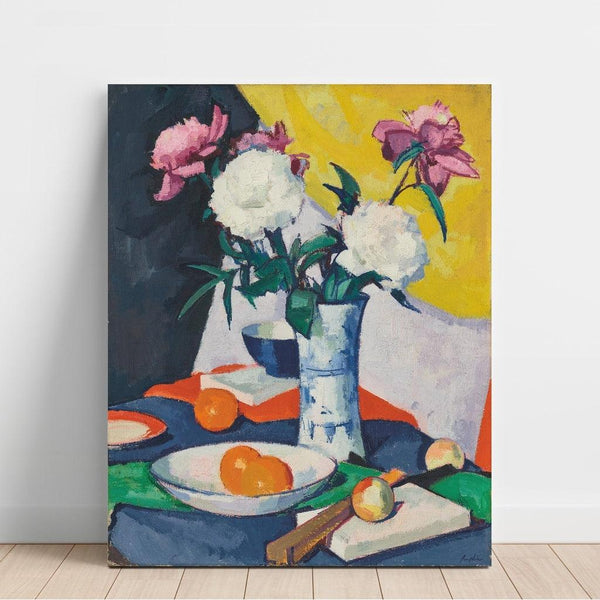
Samuel John Peploe (1871-1935) ranks among the painters who brought a modern sensibility into Scottish art at the beginning of the twentieth century. Associated with the group later known as the Scottish Colourists, he devoted his career to patient work on colour, light and the construction of space. Still lifes of roses, landscapes of the French coast or of the island of Iona: his work bears witness to a constant formal rigour, nourished by the French painting of his time yet never surrendering an identity of its own. This article sets out to retrace his career and to shed light on what, even today, makes his painting immediately recognisable.
A Scottish painter at the turn of modernity
Born in Edinburgh in 1871, Peploe trained first in his native city, notably within the Scottish artistic institutions, before staying in Paris to complete his apprenticeship. The French capital, where he attended the independent academies, offered him direct contact with a pictorial tradition he deeply admired. His early works bear the mark of this discovery: portraits and still lifes are treated in a dark range, with a broad, assured touch that owes much to the example of Manet and to the masters of the past he studied in the museums.
At this stage, Peploe often worked against a neutral or dark background, drawing his subjects out of a carefully modulated half-light. The virtuosity of the brush, the frankness of the gesture and the sense of contrast characterise this period. One can already sense an artist attentive to the organisation of the canvas, concerned less with anecdote than with the rightness of a harmony of tones. This rigour would never leave him, even when his palette opened up to brighter colours.

From Paris to colour: the making of an eye
Peploe's extended stay in Paris, around 1910, marks a decisive shift. The city was then the home of the most advanced experiments, and the painter observed at close hand the developments of Post-Impressionist and Fauve painting. Contact with these currents transformed his manner: the palette brightened, the colours gained in intensity, and the construction of form became sharper. The example of Cézanne, in particular, prompted him to conceive the painting as a rigorous assembly of planes and volumes.
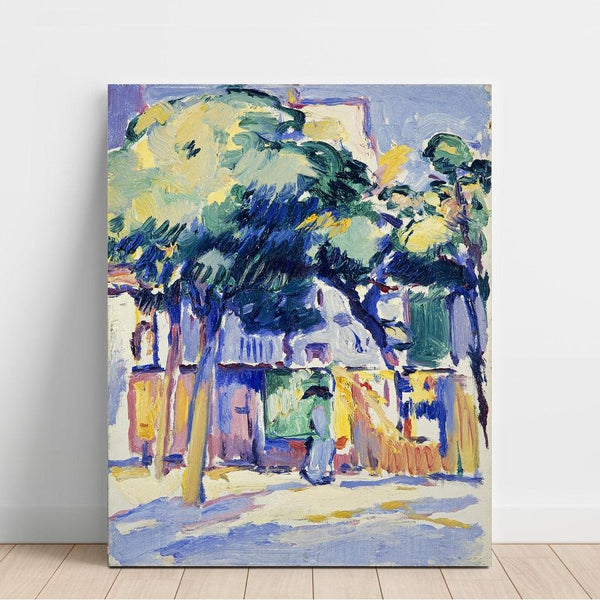
This French period also nourished his taste for landscape worked directly from the motif. On the Normandy coast, Peploe painted seaside scenes in which one finds his search for a clear light and a solid composition; a work such as Veules-les-Roses belongs to these open-air campaigns conducted far from the studio. There the painter tested his craft against the changing conditions of light, an exercise that refined his perception of colour relationships and prepared the later landscapes.

Back in Scotland, Peploe renounced none of these gains. On the contrary, he integrated them into a personal practice, in which the Parisian teaching served a vision of his own. It was from this synthesis that his artistic maturity would emerge, in the years following the First World War.
Still lifes and landscapes: the balance of an art
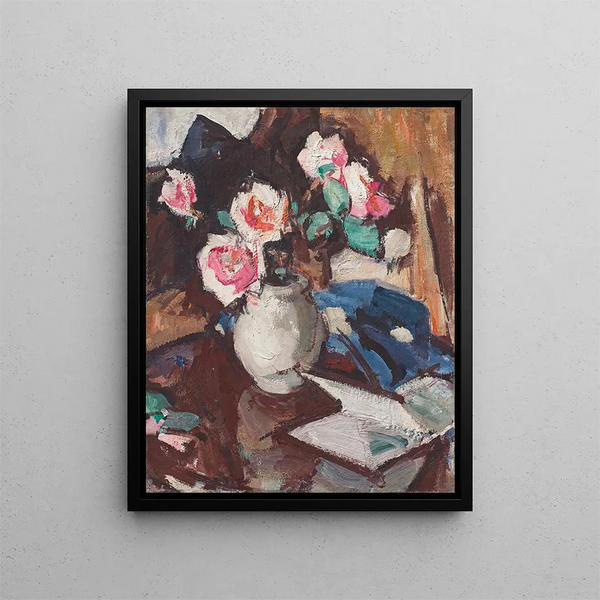
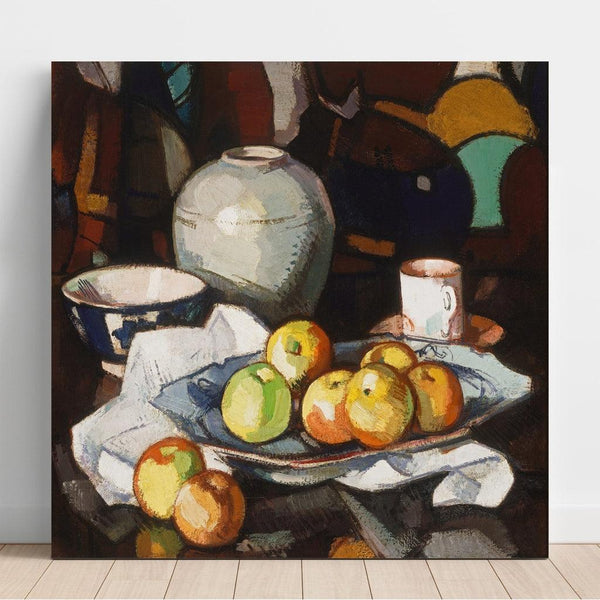
Still life holds a central place in Peploe's work, to the point of forming its most emblematic motif. Roses, tulips, fruit, fans, glasses and drapery become the elements of a vocabulary he takes up tirelessly, less through repetition than through deepening. Each canvas is the occasion for a new balance: the arrangement of the objects, the tension between the background and the foreground, the dialogue of complementary colours. A composition such as Roses in a Vase Against an Orange Background illustrates this way of making a bouquet vibrate against a coloured backdrop, where the flower becomes a pretext for a meditation on form and light.

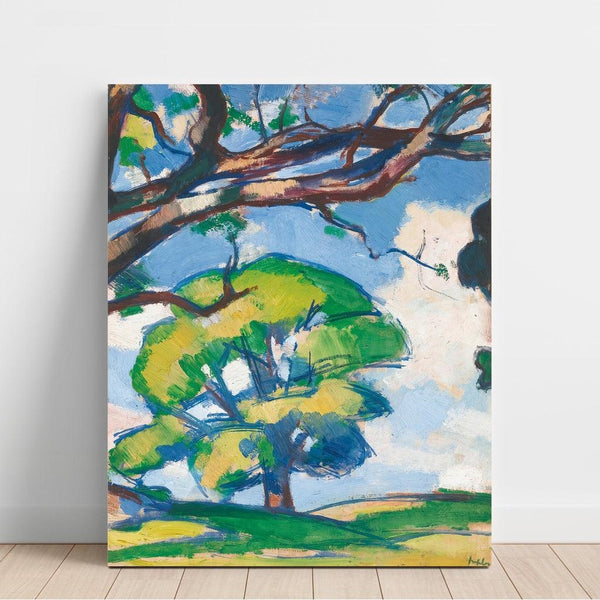
Landscape constitutes the other side of his work. Peploe stayed on several occasions in the south of France, notably at Cassis, whose Mediterranean light and sober architecture offered him subjects to his measure. Church at Cassis belongs to this vein: the volumes of the built forms, the clarity of the sky and the structure of the planes are rendered with an economy of means characteristic of his maturity. There the painter sought not the picturesque so much as the framework of a landscape, the way in which colour can organise its space.
In Scotland, the island of Iona became for Peploe a favourite motif, which he painted over the course of many summers. The beaches, the rocks and the changing waters of the island inspired canvases in which colour remains firm and luminous despite the variability of the climate. Between the Mediterranean and the Atlantic, between the studio and the open air, his work thus finds a coherence: everywhere, it is the same search for a true harmony between light, form and hue.
A Colourist legacy

Peploe's name is today inseparable from that of the Scottish Colourists, a group that retrospectively brings together four artists — Peploe himself, Francis Cadell, Leslie Hunter and John Duncan Fergusson — sharing an attachment to colour and a sustained dialogue with French painting. This label, coined after the fact, designates less an organised school than an affinity of concerns. It helped to gain recognition, in Scotland and beyond, for a generation that knew how to bring together local tradition and continental modernity.
In his lifetime, Peploe enjoyed the support of attentive dealers, who took part in the diffusion of his work and in the building of a public of collectors. His reputation, solid from the interwar years onward, has never ceased to strengthen since. His still lifes, in particular, are regarded as references of the genre, prized for their balance and the sureness of their craft.
Present today in the great Scottish public collections and on the art market, Peploe remains an essential figure for anyone interested in British painting of the early twentieth century. His work invites a patient gaze, alert to the nuances of a coloured harmony or to the rightness of a composition. Therein perhaps lies his most lasting lesson: to remind us that painting, before being subject matter, is first of all a matter of light and measure.
Discover the full range of Samuel John Peploe painting reproductions.